
Factory-Direct Supply of Certified Wires and Conductors for Diverse Industrial Applications
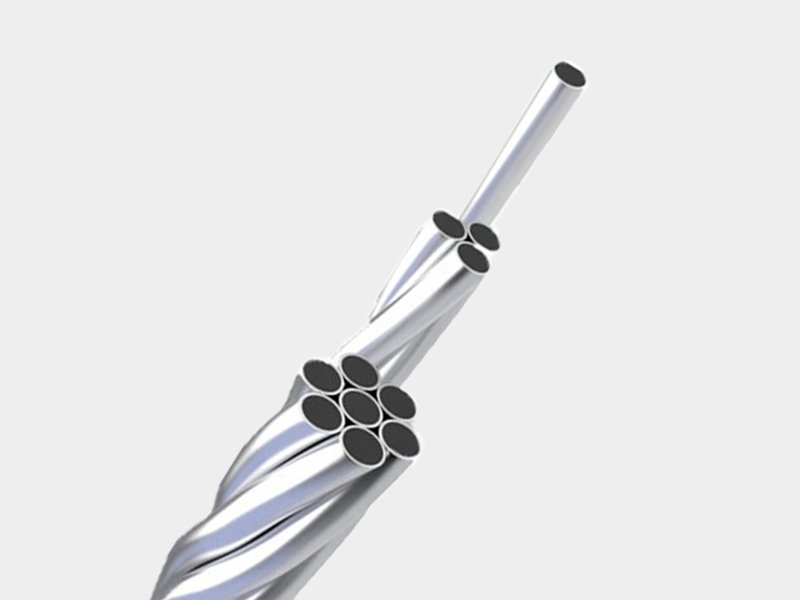
ACS Alumoweld Aluminium Clad Steel Wire DIN 48201 Standard
Standard: DIN 48201 (Aluminium-clad steel wire for overhead lines)
Related Standards: ASTM B416 / IEC 61232 / AS 1222.2
Aluminium Cladding: 25% of total cross-sectional area (metallurgical bond)
Conductivity: ~20.3% IACS
Construction: 7-wire / 19-wire / 37-wire / 61-wire concentric-lay stranded
Nominal Area Range: 25 / 35 / 50 / 70 / 95 / 120 / 150 / 185 / 240 / 300 mm²
Max. Operating Temperature: 150°C
Surface: Bare aluminium outer layer
Product Overview
ACS — Alumoweld Aluminum Clad Steel Wire (DIN 48201) is manufactured to the German national standard DIN 48201 — the same Alumoweld construction as ASTM B416 but using the metric mm² cross-section series and DIN stranding configurations. A high-tensile steel core is clad with a continuous metallurgically bonded aluminium outer layer constituting 25% of the total cross-sectional area, delivering approximately 20.3% IACS conductivity with the full tensile strength of the steel core. DIN 48201 ACS is specified for overhead earth wire, OPGW core, ACSR/AW core, and messenger wire on projects across Germany, Central Europe, and the extensive network of countries where DIN standards govern electrical infrastructure procurement — including large parts of sub-Saharan Africa, the Middle East, and Southeast Asia.
The DIN 48201 size series — 25 mm² to 300 mm² in 7-wire, 19-wire, 37-wire, and 61-wire constructions — uses the same preferred mm² cross-section numbers as DIN AAC and ACSR conductors, enabling seamless integration with DIN-standard overhead line design drawings and hardware specifications without any AWG conversion. This direct compatibility makes DIN 48201 ACS the natural choice for projects that already specify DIN conductors for their aluminium and steel core requirements.
DIN 48201 — German & DIN-Market Standard
Full compliance with the German national ACS wire standard — accepted by German, Austrian, Swiss, and Central European utilities, and for projects in Africa, the Middle East, and Southeast Asia where DIN standards are the governing electrical infrastructure specification.
Metric mm² Size Series
DIN 48201 uses 25–300 mm² nominal cross-sections — directly compatible with DIN-standard AAC, ACSR, and AAAC conductors in the same project. No AWG/kcmil conversion required; DIN hardware, clamps, and compression fittings are catalogued by mm² cross-section to match.
25% Al Cladding — Metallurgical Bond
The aluminium layer (25% of total cross-section by area) is co-drawn with the steel core during manufacture — creating a true metallurgical bond that cannot delaminate in service under any bending, tension, vibration, or thermal cycling condition encountered on overhead lines.
~20.3% IACS Conductivity
Adequate for overhead earth wire fault current duty and substantially better than galvanised steel wire (~17% IACS). The aluminium outer layer carries the majority of earth fault current due to the skin effect at power frequency, making effective ACS conductivity higher than its DC IACS rating for AC applications.
Permanent Aluminium Corrosion Protection
The aluminium cladding self-passivates to form a stable Al₂O₃ layer — providing permanent atmospheric and moderate soil corrosion protection without zinc depletion. DIN ACS outlasts galvanised steel wire in coastal, tropical, and industrially polluted environments that are common in the DIN-standard markets of Africa, the Gulf, and Southeast Asia.
Lighter Than CCS for Equal Tensile Strength
Aluminium cladding (2.70 g/cm³) is far lighter than copper cladding (8.89 g/cm³). For equivalent rated tensile strength, DIN ACS is significantly lighter than DIN CCS — reducing dead load on towers and enabling longer spans on DIN-standard overhead lines.
Technical Specifications
Basic Parameters
| Standard | DIN 48201 — Aluminium-clad steel wire (Alumoweld) for overhead lines |
|---|---|
| Related Standards | ASTM B416 (North American equivalent); IEC 61232 (international equivalent); AS 1222.2 (Australian) |
| Conductor Structure | High-tensile steel core with continuous metallurgically bonded aluminium outer layer |
| Aluminium Cladding Ratio | 25% of total cross-sectional area (by area) |
| Conductivity | ~20.3% IACS |
| Construction | 7-wire, 19-wire, 37-wire, 61-wire concentric-lay stranded |
| Nominal Area Range | 25 mm² to 300 mm² — 10 standard sizes |
| Max. Operating Temperature | Up to 150°C (continuous) |
| Surface | Bare aluminium outer surface; no additional coating required |
| Packaging | Wooden or steel drum; custom lengths available |
Full Parameter Table — DIN 48201 ACS Conductor (Hongda Data)
| Code Number (mm²) | Calc. Area (mm²) | No. of Wires | Wire Ø (mm) | Overall Ø (mm) | Weight (kg/km) | Rated Strength (kN) | DC Resistance (Ω/km, 20°C) |
|---|---|---|---|---|---|---|---|
| 25 | 24.25 | 7 | 2.10 | 6.30 | 162 | 31.56 | 3.546 |
| 35 | 34.36 | 7 | 2.50 | 7.50 | 229 | 44.72 | 2.499 |
| 50 | 49.48 | 7 | 3.00 | 9.00 | 330 | 64.40 | 1.736 |
| 70 | 65.81 | 19 | 2.10 | 10.50 | 441 | 85.65 | 1.313 |
| 95 | 93.27 | 19 | 2.50 | 12.50 | 626 | 121.39 | 0.925 |
| 120 | 116.99 | 19 | 2.80 | 14.00 | 785 | 152.26 | 0.737 |
| 150 | 147.11 | 37 | 2.25 | 15.70 | 990 | 191.46 | 0.587 |
| 185 | 181.62 | 37 | 2.50 | 17.50 | 1221 | 236.38 | 0.476 |
| 240 | 242.54 | 61 | 2.25 | 20.20 | 1635 | 299.05 | 0.357 |
| 300 | 299.43 | 61 | 2.50 | 22.50 | 2017 | 369.20 | 0.289 |
Key Features & Technical Advantages
DIN 48201 ACS vs ASTM B416 ACS vs IEC 61232 ACS
| Parameter | DIN 48201 (this product) | ASTM B416 | IEC 61232 |
|---|---|---|---|
| Primary market | Germany, Central Europe, DIN-market Africa/ME/Asia | USA, Canada, North America | IEC-market global |
| Size designation | mm² (DIN preferred series: 25–300 mm²) | AWG (No.10–No.5, 3/7/19/37-wire) | mm² (IEC preferred series) |
| Stranding series | 7/19/37/61-wire (DIN) | 3/7/19/37-wire (ASTM) | 7/19/37/61-wire (IEC) |
| Al cladding ratio | 25% cross-section area | 25% cross-section area | 25% cross-section area |
| Conductivity | ~20.3% IACS | ~20.3% IACS | ~20.3% IACS |
| DIN hardware compatibility | ✅ Direct match | ❌ AWG conversion required | ⚠️ IEC/DIN mm² overlap |
Direct DIN Hardware Compatibility
DIN 48201 ACS conductor diameters match DIN-catalogued overhead line hardware — suspension clamps, deadend assemblies, compression joints, and OPGW hardware sized for DIN conductor diameters. No conversion table needed; specify DIN ACS 95 mm² and the hardware catalogue entry is unambiguous.
Consistent with DIN AAC & ACSR Size Series
DIN ACS uses the same 25/35/50/70/95/120/150/185/240/300 mm² cross-section numbers as DIN AAC and DIN ACSR. All three conductor types can be specified on a single DIN project drawing using a consistent size designation system — simplifying procurement, QC documentation, and asset management across the full overhead line conductor inventory.
ACSR/AW Core for DIN Projects
DIN ACS wire is the standard core for DIN-standard ACSR/AW (aluminium conductor, Alumoweld reinforced) — replacing galvanised steel core in standard DIN ACSR to eliminate galvanic corrosion at the aluminium-steel interface in coastal and tropical DIN-specification overhead line projects.
High Temperature Operation
DIN ACS operates continuously up to 150°C — compatible with high-temperature low-sag conductor designs where line sections are thermally upgraded without tower modification. This temperature rating significantly exceeds the 80°C limit of conventional DIN ACSR conductors.
DIN-Market Corrosion Resistance
Many DIN-standard markets in Africa and the Gulf have coastal or high-humidity environments where galvanised steel wire earth wire has documented 15–20 year corrosion failures. DIN ACS provides the same mechanical performance as galvanised steel with permanent aluminium corrosion protection — eliminating premature earth wire replacement costs.
Multi-Standard Compliance
ACS wire manufactured to DIN 48201 can simultaneously be certified to ASTM B416 and IEC 61232 for projects requiring dual-standard documentation — the same 25% aluminium cladding ratio and steel core construction satisfies all three standards; only the test report format and size designation change.
Certifications & Standards
Typical Applications
Overhead Earth Wire (DIN Projects)
Ground wire on DIN-standard HV transmission lines — ACS provides high tensile strength and permanent corrosion resistance without the zinc depletion risk of galvanised steel wire.
OPGW Core (DIN-Market)
Core element of OPGW cables on DIN-specification projects — ACS tensile strength and aluminium corrosion protection for 25–40 year optical ground wire service life.
ACSR/AW Core (DIN Projects)
Replaces galvanised steel core in DIN-standard ACSR/AW — eliminating galvanic corrosion at the aluminium-steel interface for DIN-specification transmission lines in coastal and tropical environments.
Central European Utilities
German, Austrian, Swiss, and Central European HV line projects where DIN 48201 is the governing overhead earth wire standard — direct procurement compliance without standard conversion.
DIN-Standard Africa & Middle East
Overhead earth wire on DIN-specification infrastructure projects in sub-Saharan Africa, the Gulf, and North Africa — ACS corrosion resistance for coastal and high-humidity DIN-market environments.
Southeast Asian DIN Projects
Overhead lines in Indonesia, Vietnam, Thailand, and Malaysia where DIN standards are adopted for transmission infrastructure — DIN ACS mm² sizing integrates directly with project specifications.
Messenger Wire
Support strand for aerial cables and ADSS fibre on DIN-specification projects — lighter than CCS messenger, more corrosion-resistant than galvanised steel strand for long-term outdoor service.
Coastal & Tropical Lines
Overhead earth wire in salt-laden coastal and humid tropical environments across DIN-market regions where galvanised steel earth wire requires 15–20 year replacement — ACS eliminates that replacement cycle.
Related Products
North American standard ACS — AWG sizes, 3/7/19/37-wire, for NESC-compliant projects in the USA and Canada
IEC international standard ACS — mm² sizing for IEC-specification projects globally
DIN standard all-aluminium overhead conductor — same mm² series as DIN ACS for consistent project specification
Request a Quote
Frequently Asked Questions
As a factory, we offer flexible MOQ depending on the cable type. For standard stock items, MOQ is low; for customized specifications, please contact our sales team for a detailed quote.
Yes, Qiangli cables are manufactured in compliance with international standards such as UL, CE, TUV, and VDE. We provide full test reports and certificates upon request.
Absolutely. We have a dedicated R&D team that can customize cable structure, material, color, and printing to meet your specific project needs.
For standard products, lead time is usually 7-15 days. For large-scale project orders or customized products, it typically ranges from 20 to 30 days.
Yes, we provide free samples for most standard cables. You only need to cover the international courier costs. Contact us to arrange your sample shipment.