
Product Overview
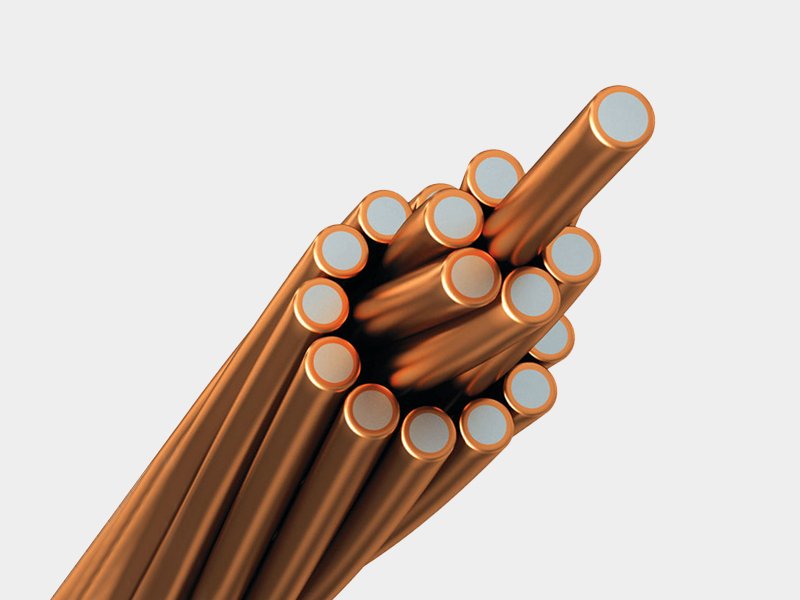
Copper Clad Steel Conductor (CCS) is a composite overhead and grounding conductor that combines a high-tensile steel core with a continuous metallurgically bonded copper outer layer — delivering the electrical conductivity of copper and the mechanical tensile strength of steel in a single wire. The copper layer is not a coating or plating but a true metallurgical bond — drawn down with the steel during the wire drawing process so that the copper and steel deform together, creating an inseparable interface with no delamination risk in service.
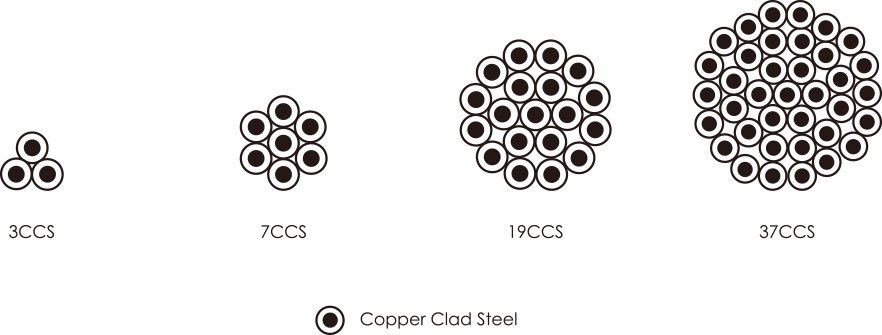
CCS conductors are available in two conductivity grades: 40% IACS (higher copper cladding percentage, better conductivity) and 30% IACS (thinner copper layer, higher steel core fraction, higher tensile strength). Each grade is available in two mechanical strength classes: HS (High Strength) and EHS (Extra High Strength) — giving four product variants: 40HS, 30HS, and 30EHS being the most commonly specified. The IEC-standard size series covers nominal cross-sections from 15 mm² to 320 mm² in 3-wire, 7-wire, and 19-wire concentric-lay constructions.
A practical advantage unique to CCS: its near-zero scrap value compared to bare copper and its extreme difficulty to cut with conventional wire cutting tools significantly reduces theft risk — a decisive factor for long-run buried grounding grids, rural overhead earth wires, and remote infrastructure installations.
Copper Outer Layer — Continuous metallurgical bond; 40% IACS (thick cladding) or 30% IACS (thin cladding)
Steel Core — High-carbon steel; HS grade (~1300 MPa) or EHS grade (~1500 MPa)
Bonded Interface — No delamination; copper and steel deform together during wire drawing
IEC Grade Codes — 40HS / 30HS / 30EHS: conductivity % + strength class
Copper Conductivity + Steel Strength
40% IACS conductivity (vs 61% for pure aluminium, 100% for copper) combined with tensile strength of 3,000–30,000+ kg depending on size — a combination impossible to achieve with either material alone. CCS fills the design space between bare copper (high conductivity, low strength) and galvanised steel (high strength, poor conductivity).
Metallurgical Bond — No Delamination
The copper cladding is drawn simultaneously with the steel core during the wire manufacturing process — creating a true metallurgical bond rather than a plated or coated layer. The copper layer cannot peel, flake, or separate in service, ensuring consistent conductivity and corrosion protection across the conductor's full service life.
40% or 30% IACS — Two Conductivity Grades
The 40% IACS grade has a thicker copper cladding (~40% of cross-sectional area is copper) and lower resistance — preferred for overhead earth wire where conductivity limits earth fault current impedance. The 30% IACS grade has a thinner copper layer and higher steel fraction — preferred for guy wire, messenger wire, and mechanical applications where strength dominates over conductivity.
HS & EHS Strength Grades
HS (High Strength): minimum tensile strength approximately 1270–1300 MPa — equivalent to standard galvanised steel wire. EHS (Extra High Strength): minimum tensile strength approximately 1450–1520 MPa — for long-span overhead earth wires and high-tension guy wire applications.
Theft Deterrent — Near-Zero Scrap Value
CCS has no copper scrap value to a wire fence buyer — the steel core makes it impossible to sell as copper scrap. Combined with the extreme difficulty of cutting CCS with standard wire cutters (the steel core resists conventional tools), CCS is virtually theft-proof compared to bare copper conductor — a decisive specification advantage for rural grounding grids and remote infrastructure.
Corrosion Resistant
The copper outer layer provides inherent atmospheric corrosion resistance — the copper patina self-passivates in outdoor exposure. CCS is suitable for direct burial in most soil types and atmospheric exposure without additional corrosion protection, unlike galvanised steel wire which eventually loses its zinc coating.
Technical Specifications
Basic Parameters
| Standard | IEC (international standard CCS wire and strand) |
|---|---|
| Conductor Type | Copper-clad steel (CCS) — steel core with continuous metallurgically bonded copper outer layer |
| Conductivity Grades | 40% IACS (40HS) — thick copper layer; 30% IACS (30HS / 30EHS) — thin copper layer |
| Strength Grades | HS (High Strength): min. ~1300 MPa; EHS (Extra High Strength): min. ~1500 MPa |
| Construction | 3-wire, 7-wire, or 19-wire concentric-lay stranded; single wire also available |
| Nominal Area Range | 15 mm² to 320 mm² |
| Surface | Bare copper outer surface — no additional coating required |
| Density | Intermediate between copper (8.89 g/cm³) and steel (7.85 g/cm³) — depends on Cu/St ratio |
| Operating Temperature | Up to 90°C (continuous); higher short-circuit temperature ratings available |
| Packaging | Wooden or steel drum; coil; custom lengths available |
CCS Grade Selection Guide
| Grade Code | Conductivity (% IACS) | Strength Class | Copper Layer Thickness | DC Resistance vs Pure Cu | Primary Use |
|---|---|---|---|---|---|
| 40HS | 40% | High Strength (~1300 MPa) | Thick (~21% by radius) | 2.5× bare copper | Overhead earth wire, grounding grid, neutral conductor |
| 30HS | 30% | High Strength (~1300 MPa) | Medium (~16% by radius) | 3.3× bare copper | Overhead shield wire, messenger wire, rural earth wire |
| 30EHS | 30% | Extra High Strength (~1500 MPa) | Medium (~16% by radius) | 3.3× bare copper | Long-span overhead earth wire, high-tension guy wire, river crossings |
Full Parameter Table — IEC CCS Conductor (Hongda Data)
| Nominal Area (mm²) | Stranding (No./mm) | Actual Area (mm²) | Breaking Load 40HS (kg) | Breaking Load 30HS (kg) | Breaking Load 30EHS (kg) | DC Resistance 40% IACS (Ω/km) | DC Resistance 30% IACS (Ω/km) | Weight (kg/km) 40% | Weight (kg/km) 30% |
|---|---|---|---|---|---|---|---|---|---|
| 320 | 19/4.62 | 318.71 | 22788 | 25206 | 30350 | 0.1399 | 0.1865 | 2634.0 | 2660.8 |
| 250 | 19/4.12 | 252.71 | 18849 | 20788 | 25188 | 0.1764 | 0.2352 | 2087.9 | 2110.2 |
| 200 | 19/3.67 | 200.45 | 15599 | 17118 | 20797 | 0.2225 | 0.2966 | 1656.3 | 1674.2 |
| 160 | 19/3.26 | 158.97 | 12873 | 14079 | 17096 | 0.2805 | 0.3740 | 1313.6 | 1327.2 |
| 120 | 19/2.91 | 126.06 | 10609 | 11567 | 13884 | 0.3537 | 0.4715 | 1041.7 | 1052.6 |
| 150 | 7/5.19 | 148.06 | 10120 | 11240 | 13349 | 0.3000 | 0.4000 | 1218.7 | 1231.5 |
| 120 | 7/4.62 | 117.42 | 8396 | 9285 | 11181 | 0.3783 | 0.5043 | 966.41 | 976.53 |
| 90 | 7/4.12 | 93.097 | 6954 | 7661 | 9280 | 0.4771 | 0.6359 | 766.25 | 774.29 |
| 70 | 7/3.67 | 73.871 | 5747 | 6309 | 7661 | 0.6014 | 0.8019 | 608.06 | 614.46 |
| 60 | 7/3.26 | 58.561 | 4745 | 5189 | 6300 | 0.7586 | 1.0109 | 482.02 | 487.07 |
| 50 | 7/2.91 | 46.439 | 3908 | 4261 | 5116 | 0.9564 | 1.2750 | 382.16 | 386.18 |
| 35 | 7/2.59 | 36.826 | 3230 | 3519 | 4171 | 1.2061 | 1.6077 | 303.14 | 306.26 |
| 50 | 3/4.62 | 50.322 | 3798 | 4201 | 5380 | 0.8809 | 1.1743 | 413.41 | 417.73 |
| 40 | 3/4.12 | 39.903 | 3145 | 3465 | 4424 | 1.1106 | 1.4807 | 327.84 | 331.26 |
| 30 | 3/3.67 | 31.645 | 2600 | 2854 | 3593 | 1.4007 | 1.8672 | 259.98 | 262.66 |
| 25 | 3/3.26 | 25.097 | 2145 | 2347 | 2849 | 1.7662 | 2.3544 | 206.11 | 208.34 |
| 20 | 3/2.91 | 19.903 | 1768 | 1928 | 2326 | 2.2271 | 2.9690 | 163.55 | 165.19 |
| 15 | 3/2.59 | 15.781 | 1461 | 1592 | 1887 | 2.8082 | 3.7436 | 129.62 | 130.99 |
Key Features & Technical Advantages
CCS vs Bare Copper vs Galvanised Steel — When to Choose CCS
| Parameter | CCS 40% IACS | Bare Copper (100% IACS) | Galvanised Steel Wire |
|---|---|---|---|
| Conductivity | 40% IACS | 100% IACS (best) | ~17% IACS (worst) |
| Tensile strength | High (~1300–1500 MPa) | Low (220–415 MPa) | High (~1300–1720 MPa) |
| Corrosion resistance | Excellent (copper patina) | Excellent | Good (while zinc lasts) |
| Theft risk | Very low (no Cu scrap value) | Very high (high Cu scrap value) | Very low |
| Weight | Intermediate | Heavy (8.89 g/cm³) | Heavy (7.85 g/cm³) |
| Direct burial suitability | Excellent | Excellent | Limited (zinc depletes) |
| Best for | Earth wire, grounding grid, long-span shield wire | Short overhead jumpers, grounding electrode conductors in secure locations | Guy wire, messenger, ACSR core |
Fault Current Capacity
During an earth fault, the grounding conductor must carry fault current for the protective relay clearance time (0.05–3 seconds). CCS's combination of conductivity and large cross-section gives it fault current capacity comparable to bare copper at the same nominal area — far superior to galvanised steel wire of the same cross-section.
Anti-Theft for Remote Installations
Bare copper grounding grid theft is a critical infrastructure security problem in many regions. CCS has no recoverable copper scrap value at scrap dealers (the steel makes separation uneconomical), and cannot be cut with standard wire cutters. CCS grounding grids remain in service; bare copper grids are repeatedly stolen and replaced.
Superior to Galvanised Steel for Long-Term Burial
Zinc galvanising on steel wire provides cathodic protection only while the zinc coating persists — typically 15–25 years in most soil types. CCS's copper outer layer provides permanent corrosion protection with no depletion mechanism — CCS grounding electrodes remain electrically effective for 40+ years in direct burial without deterioration.
High Skin Effect Efficiency at Power Frequency
At 50 or 60 Hz power frequency, alternating current concentrates in the outer (copper) layer of the conductor due to skin effect. Since CCS concentrates copper on the outside where AC current flows preferentially, CCS achieves higher effective AC conductivity than its nominal DC IACS rating would suggest for overhead earth wire applications.
Mechanical Damage Resistance
CCS withstands mechanical damage during installation — pulling through conduit, installation around sharp corners, and compression by clamps — without the copper layer detaching from the steel core. The metallurgical bond transfers mechanical stress uniformly between copper and steel throughout any deformation.
Standard Hardware Compatibility
CCS uses standard copper-compatible compression fittings, clamps, and connectors — no special tooling required compared to bare copper termination practice. The copper outer surface accepts all copper-compatible lugs, grounding clamps, and bond connectors without modification.
Certifications & Standards
Typical Applications
Overhead Earth Wire (Shield Wire)
Overhead ground wire on HV transmission lines — CCS provides the tensile strength for long spans and conductivity for fault current flow without the theft risk of bare copper.
Buried Grounding Grid
Substation and power plant grounding grids in direct burial — CCS's permanent copper corrosion resistance and anti-theft properties make it the preferred replacement for bare copper in theft-risk regions.
Substation Earthing Systems
Earthing conductors, busbars, and bonding conductors in outdoor substations — CCS handles fault current, resists corrosion, and deters theft across the exposed conductor runs.
Messenger Wire
Support strand for aerial cables and ADSS fibre — 30EHS grade provides the high tensile strength for long-span messenger applications at lower cost than bare copper strand.
Rural Overhead Earth Wire
Earth wire on rural distribution lines in regions with high conductor theft — CCS eliminates the recurring cost and outage risk of bare copper earth wire replacement after theft.
Grounding Electrode Conductors
Connection from structure or system to earth electrodes in theft-risk locations — CCS provides effective earthing with no theft incentive compared to bare copper GEC.
Lightning Protection Down Conductors
Lightning protection system down conductors on buildings and structures — CCS combines the conductivity required for lightning current with anti-theft properties for exposed outdoor installations.
Railway Track Bonding
Return current bonds and track bonding conductors in railway electrification systems — CCS resists theft and mechanical damage in track-side installations better than bare copper.