
Factory-Direct Supply of Certified Wires and Conductors for Diverse Industrial Applications
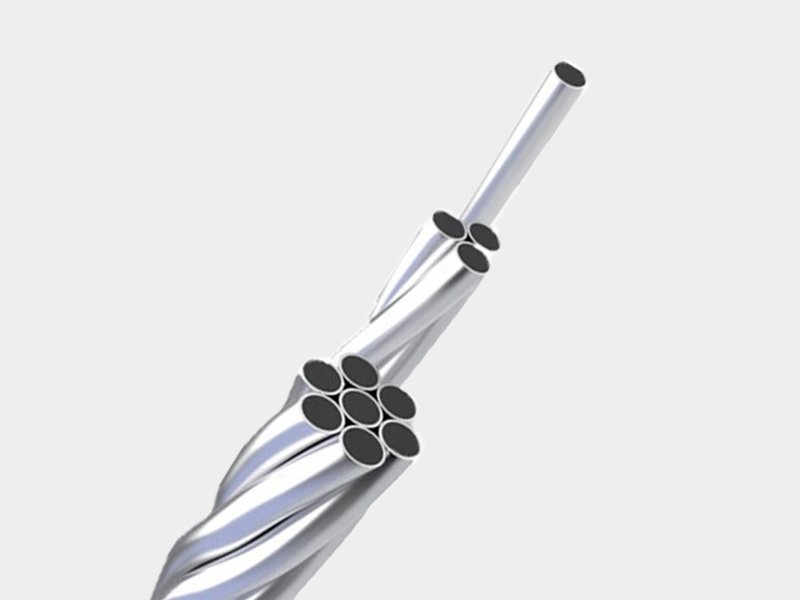
ACS Alumoweld Aluminium Clad Steel Wire IEC 61232 Standard
Standard: IEC 61232 (Aluminium-Clad Steel Wire)
Related Standards: ASTM B416 / DIN 48201 / AS 1222.2
Conductivity Classes: 20SA (20.3% IACS) / 27SA (27% IACS) / 30SA (30% IACS) / 40SA (40% IACS)
20SA Sub-types: Type A (diameter-dependent tensile 1070–1340 N/mm²) / Type B (uniform 1320 N/mm²)
Wire Diameter Range: 1.24–5.50 mm (20SA); 2.50–5.00 mm (27SA/30SA/40SA)
Max. Operating Temperature: 150°C
Diameter Tolerance: ±1.5% (Ø ≥ 2.67 mm) / ±0.04 mm (Ø < 2.67 mm)
Product Overview
ACS — Alumoweld Aluminum Clad Steel Wire (IEC 61232) is manufactured to IEC 61232 — Aluminium-Clad Steel Wire — the international standard for aluminium-clad steel (ACS) wire that defines four distinct conductivity classes: 20SA, 27SA, 30SA, and 40SA. Each class specifies a different aluminium cladding thickness, resulting in a progressively increasing conductivity from 20.3% IACS (20SA — thinnest cladding, highest steel fraction, maximum tensile strength) to 40% IACS (40SA — thickest cladding, highest conductivity, closest to CCS performance). This multi-class framework makes IEC 61232 the most versatile of the three ACS standards — engineers can select the exact conductivity/strength balance required for each specific application from a single internationally recognised standard.
The IEC 61232 standard also defines two mechanical strength sub-types for the 20SA class: Type A (highest tensile strength, diameter-dependent minimum values from 1070 to 1340 N/mm²) and Type B (slightly lower but uniform tensile strength, 1320 N/mm² for all diameters) — providing additional flexibility for applications where a consistent mechanical strength regardless of wire diameter is preferred. All four classes share the same continuous metallurgically bonded aluminium-on-steel construction and are suitable for overhead earth wire, OPGW core, ACSR/AW core, messenger wire, and long-span ground wire applications across IEC-specification markets worldwide.
Four IEC Conductivity Classes — 20SA to 40SA
IEC 61232 uniquely defines four conductivity classes: 20SA (20.3% IACS), 27SA (27% IACS), 30SA (30% IACS), and 40SA (40% IACS) — enabling precise selection of the conductivity/strength/weight trade-off for each project application from a single internationally accepted standard.
IEC 61232 — Global International Standard
Accepted by utilities across Europe, Asia, Africa, the Middle East, and Latin America for overhead earth wire, OPGW core, and messenger wire procurement. IEC 61232 provides a single reference standard for ACS wire in IEC-specification markets without the need to specify ASTM B416 or DIN 48201 separately.
Metallurgical Bond — No Delamination
Aluminium cladding is co-drawn with the steel core during manufacture — a true metallurgical bond that cannot separate under any bending, tension, vibration fatigue, or fault current thermal cycling condition encountered in service. Consistent cross-section properties from surface to core throughout service life.
Type A & Type B — Tensile Flexibility for 20SA
20SA class is available as Type A (diameter-dependent tensile strength, 1070–1340 N/mm², higher strength for smaller diameters) or Type B (uniform 1320 N/mm² for all diameters). Type B simplifies structural calculation when a single tensile value must apply across all wire diameters in a stranded conductor assembly.
High Temperature Stability
IEC 61232 ACS maintains mechanical properties up to 150°C continuous operation — significantly higher than galvanised steel wire and compatible with HTLS conductor systems and upgraded thermal rating line designs where operating temperatures exceed conventional 75–80°C limits.
Permanent Corrosion Resistance
The aluminium outer layer self-passivates to form a stable Al₂O₃ protective surface — maintaining corrosion protection for 40+ years in coastal, tropical, industrial pollution, and salt-fog environments without zinc depletion or periodic re-treatment. Specified wherever galvanised steel wire has a documented premature corrosion failure history.
Technical Specifications
IEC 61232 — Four Conductivity Classes Compared
| IEC Class | Conductivity (% IACS) | Max. Resistivity (nΩ·m, 20°C) | Al Cladding (% radius) | Density (g/cm³) | Elastic Modulus (GPa) | Lin. Exp. Coeff. (×10⁻⁶ /K) | Min. Tensile (N/mm²) | Primary Use |
|---|---|---|---|---|---|---|---|---|
| 20SA Type A | 20.3% | 84.80 | 10–14% (dia. dep.) | 6.59 | 162 | 13.0 | 1070–1340 (dia. dep.) | Overhead earth wire, OPGW core, long-span ground wire — maximum tensile strength |
| 20SA Type B | 20.3% | 84.80 | 10–14% (dia. dep.) | 6.53 | 155 | 12.6 | 1320 (uniform) | OPGW core, ACSR/AW core where uniform tensile across all wire diameters is required |
| 27SA | 27% | 63.86 | 15% | 5.91 | 140 | 13.4 | 1080 | Overhead earth wire — balanced conductivity/strength for moderate spans |
| 30SA | 30% | 57.47 | ~19% | 5.61 | 132 | 13.8 | 880 | Overhead earth wire, messenger wire — higher conductivity for better earth fault current capacity |
| 40SA | 40% | 43.10 | 25% | 4.64 | 109 | 15.5 | 680 | Overhead neutral, grounding conductor — maximum conductivity, approaching CCS performance |
Basic Parameters (Common to All Classes)
| Standard | IEC 61232 — Aluminium-Clad Steel Wire |
|---|---|
| Related Standards | ASTM B416 (North American equivalent); DIN 48201 (German equivalent); AS 1222.2 (Australian) |
| Conductor Structure | High-tensile steel core with continuous metallurgically bonded aluminium outer layer |
| Conductivity Classes | 20SA (20.3% IACS) / 27SA (27% IACS) / 30SA (30% IACS) / 40SA (40% IACS) |
| 20SA Sub-types | Type A (diameter-dependent tensile, 1070–1340 N/mm²) / Type B (uniform 1320 N/mm²) |
| Wire Diameter Range | 1.24 mm to 5.50 mm (20SA); 2.50 mm to 5.00 mm (27SA/30SA/40SA) |
| Diameter Tolerance | ±1.5% for Ø ≥ 2.67 mm; ±0.04 mm for Ø < 2.67 mm |
| Max. Operating Temperature | Up to 150°C (continuous) |
| Surface | Bare aluminium outer surface — no additional coating required |
| Packaging | Wooden or steel drum; single wire coil; custom lengths available |
20SA Mechanical Properties — Type A (Diameter-Dependent Tensile Strength)
| Nominal Diameter Range (mm) | Min. Tensile Strength (N/mm²) | Min. Stress at 1% Extension (N/mm²) | Min. Elongation (%) | Torsion Test (min. twists) |
|---|---|---|---|---|
| 1.24 – 3.25 | 1340 | 1200 | 1.5% | 20 |
| 3.26 – 3.45 | 1310 | 1180 | 1.5% | 20 |
| 3.46 – 3.65 | 1270 | 1140 | 1.5% | 20 |
| 3.66 – 3.95 | 1250 | 1100 | 1.5% | 20 |
| 3.96 – 4.10 | 1210 | 1100 | 1.5% | 20 |
| 4.11 – 4.40 | 1180 | 1070 | 1.5% | 20 |
| 4.41 – 4.60 | 1140 | 1030 | 1.5% | 20 |
| 4.61 – 4.75 | 1100 | 1000 | 1.5% | 20 |
| 4.76 – 5.50 | 1070 | 1000 | 1.5% | 20 |
Key Features & Technical Advantages
IEC 61232 Class Selection Guide
| IEC Class | Al Layer | Conductivity | Tensile Strength | Weight | Choose When... |
|---|---|---|---|---|---|
| 20SA Type A | Thinnest | 20.3% IACS (lowest) | Highest (1070–1340 N/mm²) | Heaviest | Maximum tensile is the primary requirement: very long spans, heavy ice/wind, OPGW core |
| 20SA Type B | Thinnest | 20.3% IACS | High (1320 N/mm² uniform) | Slightly lighter | Uniform tensile simplifies structural calculation for stranded OPGW/ACSR/AW assemblies |
| 27SA | Medium-thin | 27% IACS | High (1080 N/mm²) | Medium | Better earth fault current capacity than 20SA needed, with good tensile for moderate-long spans |
| 30SA | Medium | 30% IACS | Medium (880 N/mm²) | Lighter | Earth wire fault current duty is the main design driver; span lengths are moderate |
| 40SA | Thickest | 40% IACS (highest) | Lower (680 N/mm²) | Lightest | Maximum conductivity needed (approaching CCS 40% IACS performance) at minimum weight |
Only IEC Standard with Four Conductivity Classes
ASTM B416 and DIN 48201 define only one conductivity grade (equivalent to IEC 40SA). IEC 61232 adds 20SA, 27SA, and 30SA — providing intermediate options that enable precise matching of conductivity and tensile strength to specific overhead earth wire, OPGW, and ACSR/AW core requirements without over-specifying.
Optimised for OPGW Core Design
OPGW core selection is a precise balance: 20SA maximises tensile strength for long-span installation loads; 27SA or 30SA may be preferred where the optical fibre count and tube diameter require a larger composite cross-section to achieve the target overall conductor resistance. IEC 61232 gives OPGW designers the class resolution to hit both targets simultaneously.
Consistent Physical Properties per Class
IEC 61232 specifies density, elastic modulus, linear expansion coefficient, and temperature coefficient of resistance for each class — enabling accurate sag-tension calculations, ampacity ratings, and thermal expansion modelling for all four ACS grades using a single standard reference document.
Lower Coefficient of Thermal Expansion for 20SA/27SA
20SA and 27SA have lower coefficients of linear expansion (12.6–13.4 × 10⁻⁶ /K) than 30SA and 40SA (13.8–15.5 × 10⁻⁶ /K) — the higher steel fraction reduces thermal sag. For HTLS and high operating temperature applications, 20SA/27SA maintains lower sag at elevated temperatures than higher-Al-content grades.
Single Global Standard for All ACS Grades
IEC 61232 eliminates the need to specify ASTM B416 for 40SA grade and a separate product for 20SA/27SA/30SA. One standard, one test protocol, one data sheet — simplifying procurement documentation for international projects that span multiple engineering standards environments.
Corrosion Resistance for 40+ Year Service Life
All four IEC 61232 classes share the same aluminium cladding corrosion mechanism — self-passivating Al₂O₃ surface layer providing permanent protection in coastal, salt-fog, tropical, and industrial pollution environments without depletion, maintenance, or replacement over the full 40-year design life of modern overhead line infrastructure.
Certifications & Standards
Typical Applications by IEC Class
Overhead Earth Wire — 20SA
Long-span shield wire on EHV transmission lines — 20SA maximum tensile strength for spans exceeding 500 m and heavy ice/wind loading zones.
OPGW Core — 20SA Type A/B
Core wires in Optical Ground Wire — 20SA provides installation tensile strength while Type A/B selection matches the OPGW structural calculation method.
ACSR/AW Core — 20SA/27SA
Replaces galvanised steel core in IEC ACSR/AW — 20SA for long-span, heavy-loading lines; 27SA where slightly higher conductivity from the core is beneficial.
Coastal Earth Wire — 27SA/30SA
Overhead earth wire in marine, coastal, and high-humidity IEC-market regions where galvanised wire fails at 15–20 years — 27SA/30SA balances corrosion resistance with adequate earth fault conductivity.
Messenger Wire — 30SA/40SA
Support strand for ADSS fibre and aerial cables — 30SA/40SA provides adequate tensile strength for moderate spans with better conductivity for bonding current duties.
IEC-Market Global Projects
Europe, Africa, Middle East, Asia, and Latin America projects where IEC 61232 is the governing ACS specification — single standard covers all four conductivity grades in one procurement document.
Industrial Overhead Earth Wire — 40SA
Overhead earth wire at industrial facilities and chemical zones where higher conductivity (40SA) improves earth fault current capacity at sites with high prospective fault levels.
Rural Long-Span Lines — 20SA
Overhead earth wire on rural HV lines with long spans across flat or hilly terrain — 20SA provides the tensile strength to match the aluminium phase conductors' sag profile over the same tower configuration.
Related Products
North American standard ACS — AWG sizes, single conductivity grade (equiv. to 40SA), 3/7/19/37-wire
German standard ACS — metric mm² sizes 25–300 mm², 7/19/37/61-wire, for DIN-specification projects
Copper-clad steel — 30–40% IACS, higher conductivity for grounding grid and neutral conductor applications
Request a Quote
Frequently Asked Questions
As a factory, we offer flexible MOQ depending on the cable type. For standard stock items, MOQ is low; for customized specifications, please contact our sales team for a detailed quote.
Yes, Qiangli cables are manufactured in compliance with international standards such as UL, CE, TUV, and VDE. We provide full test reports and certificates upon request.
Absolutely. We have a dedicated R&D team that can customize cable structure, material, color, and printing to meet your specific project needs.
For standard products, lead time is usually 7-15 days. For large-scale project orders or customized products, it typically ranges from 20 to 30 days.
Yes, we provide free samples for most standard cables. You only need to cover the international courier costs. Contact us to arrange your sample shipment.