
Product Overview
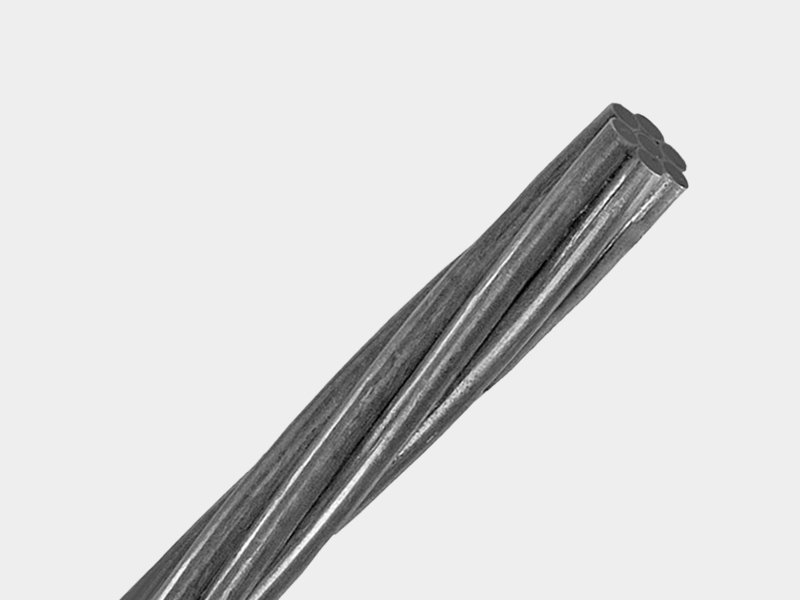
GSW — Galvanized Steel Wire Strand (ASTM A475) is a concentric-lay stranded high-carbon steel wire conductor, hot-dip zinc galvanised, manufactured to ASTM A475 — Standard Specification for Zinc-Coated Steel Wire Strand. Unlike aluminium conductors which carry electrical current, GSW is a purely mechanical conductor — its function is structural: providing tensile support as guy wire for utility poles and transmission towers, messenger wire for aerial cable support, overhead ground wire (earth wire) for lightning shielding, and structural strand for cable-stay and suspension applications. The zinc galvanising provides corrosion protection to extend the mechanical service life in outdoor environments.
ASTM A475 defines four strength grades based on the steel wire temper and tensile strength: Common (C), Siemens-Martin (SM), High-Strength (HS), and Extra High-Strength (EHS) — in order of increasing tensile strength and increasing carbon content. Each grade is available in the standard wire sizes from 1/4 inch (6.35 mm) to 1-1/4 inch (31.75 mm) overall diameter in 7-wire and 19-wire concentric-lay stranded constructions. The choice of grade depends on the required breaking strength, span length, and loading conditions of each specific application.
Outer Steel Wires — High-carbon drawn steel, hot-dip zinc galvanised
Inner Steel Wires — Concentric-lay, alternating direction per layer
Central Wire — Single steel wire core
No Copper / No Aluminium — Pure steel strand; structural purpose only
Four Strength Grades — C / SM / HS / EHS
ASTM A475 defines four grades in increasing tensile strength: Common (lowest), Siemens-Martin, High-Strength, and Extra High-Strength (highest). EHS is the most commonly specified grade for utility guy wire and long-span overhead earth wire applications requiring maximum breaking load per unit cross-section.
Hot-Dip Zinc Galvanising
All wires are hot-dip zinc galvanised per ASTM A475 coating requirements — providing cathodic corrosion protection for outdoor installation. Three coating classes (A, B, C) specify increasing zinc weight per unit surface area for progressively more corrosive environments.
7-Wire & 19-Wire Constructions
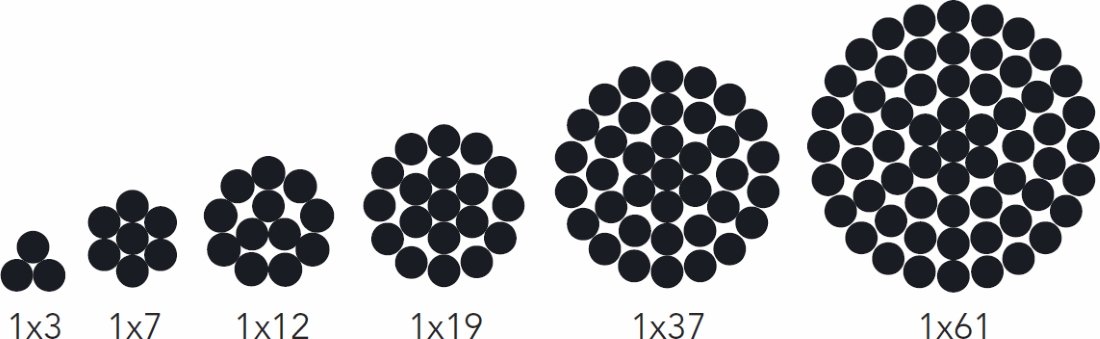
7-wire strand (1 core + 6 outer wires) is standard for sizes up to 7/16 inch. 19-wire strand provides greater flexibility and higher breaking load for larger sizes. Both constructions meet ASTM A475 dimensional and mechanical requirements.
Inch-Based Size Series
ASTM A475 uses nominal overall diameter in inches (1/4", 5/16", 3/8", 7/16", 1/2", 9/16", 5/8", 3/4", 7/8", 1", 1-1/8", 1-1/4") — directly compatible with NESC-compliant North American utility project specifications, pole hardware catalogues, and guy wire fittings sized by strand diameter.
High Tensile Strength
EHS grade steel wire achieves tensile strengths of 1520–1720 MPa depending on wire diameter — providing the highest breaking load per unit weight of any standard bare conductor type. This extreme strength-to-weight ratio makes GSW indispensable for guy wire and long-span structural applications where no other conductor type is adequate.
NESC & RUS Compliance
ASTM A475 galvanised steel strand is specified in the National Electrical Safety Code (NESC) and USDA Rural Utilities Service (RUS) standards for utility pole guying — mandatory for US and Canadian rural electric cooperative (REC) infrastructure projects.
Technical Specifications
Basic Parameters
| Standard | ASTM A475 — Standard Specification for Zinc-Coated Steel Wire Strand |
|---|---|
| Related Standards | ASTM A475 / ASTM A363 (zinc coating) / ASTM A641 (galvanised wire) |
| Wire Material | High-carbon drawn steel wire, hot-dip zinc galvanised |
| Strength Grades | Common (C) / Siemens-Martin (SM) / High-Strength (HS) / Extra High-Strength (EHS) |
| Zinc Coating Classes | Class A (standard) / Class B (medium) / Class C (heavy — most corrosive environments) |
| Construction | 7-wire concentric-lay (small sizes); 19-wire concentric-lay (large sizes) |
| Size Range | 1/4 inch (6.35 mm) to 1-1/4 inch (31.75 mm) overall diameter |
| Primary Use | Mechanical / structural only — guy wire, messenger, overhead earth wire, cable-stay |
| Conductivity | ~17% IACS (steel) — not a current-carrying conductor in typical applications |
| Packaging | Reel or drum; standard lengths 500 ft / 1000 ft / 2500 ft; metric lengths available |
Strength Grade Comparison
| Grade | Code | Min. Wire Tensile Strength | Typical Carbon Content | Breaking Load (relative) | Primary Applications |
|---|---|---|---|---|---|
| Common | C | ~1030–1210 MPa (dia. dep.) | Low-medium carbon | Base reference | Light-duty guying, temporary strand, low-load applications |
| Siemens-Martin | SM | ~1210–1380 MPa | Medium carbon | ~15% above Common | Standard utility pole guying, distribution line guy wire |
| High-Strength | HS | ~1380–1520 MPa | High carbon | ~30% above Common | Transmission tower guys, long-span ground wire, heavy loading |
| Extra High-Strength | EHS | ~1520–1720 MPa | Very high carbon | ~50% above Common | EHV tower guys, river crossing guys, maximum loading conditions |
Full Parameter Table — ASTM A475 GSW (Hongda Data)
| Dia. (in.) | Dia. (mm) | No. Wires | Wire Ø (in.) | Area (in²) | Area (mm²) | Weight (lb/ft) | Weight (kg/km) | Breaking Load Common (lbf) | Breaking Load SM (lbf) | Breaking Load HS (lbf) | Breaking Load EHS (lbf) |
|---|---|---|---|---|---|---|---|---|---|---|---|
| 1/4 | 6.35 | 7 | 0.083 | 0.0302 | 19.48 | 0.104 | 154.8 | 3,100 | 3,600 | 4,000 | 4,750 |
| 5/16 | 7.94 | 7 | 0.104 | 0.0472 | 30.45 | 0.163 | 242.4 | 4,750 | 5,600 | 6,400 | 7,650 |
| 3/8 | 9.53 | 7 | 0.125 | 0.0682 | 44.00 | 0.235 | 349.7 | 6,750 | 8,000 | 9,350 | 11,200 |
| 7/16 | 11.11 | 7 | 0.145 | 0.0922 | 59.48 | 0.318 | 473.0 | 9,000 | 10,800 | 12,500 | 15,400 |
| 1/2 | 12.70 | 7 | 0.166 | 0.1208 | 77.94 | 0.417 | 620.3 | 11,500 | 14,000 | 16,800 | 20,800 |
| 9/16 | 14.29 | 7 | 0.187 | 0.1532 | 98.84 | 0.529 | 786.9 | 14,500 | 17,500 | 21,300 | 26,600 |
| 5/8 | 15.88 | 7 | 0.207 | 0.1878 | 121.16 | 0.648 | 964.2 | 17,500 | 21,800 | 26,100 | 32,900 |
| 3/4 | 19.05 | 7 | 0.250 | 0.2734 | 176.39 | 0.944 | 1404.4 | 25,400 | 31,300 | 38,000 | 47,400 |
| 7/8 | 22.23 | 7 | 0.291 | 0.3714 | 239.61 | 1.283 | 1908.5 | 34,000 | 42,400 | 51,700 | 64,400 |
| 1 | 25.40 | 7 | 0.332 | 0.4840 | 312.26 | 1.671 | 2486.0 | 44,000 | 55,000 | 67,500 | 83,600 |
| 1 | 25.40 | 19 | 0.201 | 0.6033 | 389.23 | 2.083 | 3099.2 | 49,800 | — | 77,700 | 96,900 |
| 1-1/8 | 28.58 | 19 | 0.226 | 0.7620 | 491.62 | 2.633 | 3917.4 | 62,600 | — | 98,200 | 122,000 |
| 1-1/4 | 31.75 | 19 | 0.250 | 0.9354 | 603.48 | 3.231 | 4807.2 | 76,800 | — | 120,000 | 150,000 |
Key Features & Technical Advantages
Highest Breaking Load per Diameter
EHS grade GSW achieves breaking loads of 4,750 lbf (1/4") to 150,000 lbf (1-1/4") — the highest of any standard overhead conductor type at equivalent diameter. No aluminium, copper, or composite conductor approaches the tensile strength of high-carbon galvanised steel strand of the same cross-section.
Hot-Dip Zinc Galvanising — Three Coating Classes
Class A coating provides standard outdoor corrosion protection adequate for most inland and suburban environments. Class B doubles the zinc weight for coastal and moderately corrosive industrial zones. Class C provides maximum zinc protection for severe marine, chemical, and tropical environments where zinc depletion is the dominant service life factor.
NESC / RUS Compliance for US Utilities
ASTM A475 galvanised steel strand is the mandatory specification for pole guy wire under the National Electrical Safety Code (NESC C2-2017, Rule 261) and USDA RUS Bulletin 1728F-803. All US and Canadian utility and cooperative distribution and transmission line guying must use ASTM A475 strand — no equivalent specification is accepted.
Self-Damping for Overhead Earth Wire
Multi-wire steel strand dissipates Aeolian vibration energy more effectively than solid steel rod — the inter-wire friction and relative movement between strands act as a mechanical damper, reducing the vibration amplitude that causes fatigue cracking at clamp locations. This self-damping property significantly extends service life on overhead earth wire compared to equivalent single-wire construction.
Low Creep Rate
High-carbon steel has inherently low creep rate at ambient temperatures — GSW strand maintains its stringing tension over decades of service without significant permanent elongation. This low creep characteristic is why steel strand is used for guy wire and messenger rather than aluminium, which creeps significantly at sustained tensile loads.
Economical for Mechanical Applications
Where the application requires tensile strength rather than electrical conductivity — guying, messenger, structural cable — galvanised steel strand is the most economical solution. ACS (Alumoweld) and CCS provide additional conductivity at higher cost; for pure mechanical duty, ASTM A475 GSW delivers maximum breaking load at minimum material cost.
GSW vs ACS vs CCS — When to Choose Each
| Parameter | GSW (ASTM A475) | ACS Alumoweld | CCS Copper Clad |
|---|---|---|---|
| Conductivity | ~17% IACS (lowest) | ~20.3% IACS | 30–40% IACS (highest) |
| Tensile strength | Very high (EHS grade) | High | High |
| Weight (same strength) | Medium | Lightest | Heaviest |
| Long-term corrosion | Good (while zinc lasts) | Excellent (permanent Al) | Excellent (permanent Cu) |
| Cost | Lowest | Medium | Highest |
| Guy wire | ✅ Standard choice | ✅ Suitable | ⚠️ Overspec for pure guying |
| Overhead earth wire | ✅ Standard for inland | ✅ Better for coastal | ✅ Best conductivity |
| OPGW core | ❌ Corrosion risk long-term | ✅ Standard choice | ⚠️ Too heavy |
| Buried grounding | ❌ Zinc depletes | ⚠️ Moderate | ✅ Best choice |
Certifications & Standards
Typical Applications
Utility Pole Guy Wire
Tensile support for wood, concrete, and steel utility poles on distribution and sub-transmission lines — the primary and most common application for ASTM A475 GSW worldwide.
Transmission Tower Guy Wire
EHS and HS grade strand for guying steel lattice and monopole transmission towers on HV and EHV lines — very large breaking loads required for tall structures under heavy wind and ice loading.
Overhead Earth Wire (Ground Wire)
Static wire on overhead transmission lines for lightning shielding — GSW provides the tensile strength to match the sag profile of the phase conductors while providing a path for induced lightning current to earth.
Messenger Wire
Structural support strand for self-supporting aerial cable (ADSS figure-8), drop wire, and lashed cable on utility poles — GSW messenger is the standard support for aerial telecommunications and power cable installations.
River & Valley Crossings
Long-span crossing structures where EHS strand provides the maximum breaking load for spans of 500–2000+ metres — river crossings, ravine crossings, and mountain approach spans for major transmission lines.
Distribution Line Guying
SM and HS grade strand for guying distribution poles at angles, road crossings, and dead-ends — the most common application for 3/8" and 7/16" EHS or HS grade in US distribution networks.
Structural Cable & Cable-Stay
Structural strand for cable-stay bridges, guyed masts, antenna towers, and wind turbine tower guys — EHS grade provides the highest breaking load for structural applications where steel strand is the design material.
Rural Electrification (RUS)
USDA RUS-compliant guying for rural distribution lines built under the US Rural Utilities Service program — ASTM A475 EHS is the standard specification in RUS Bulletin 1728F-803 for all pole guying.