
Product Overview
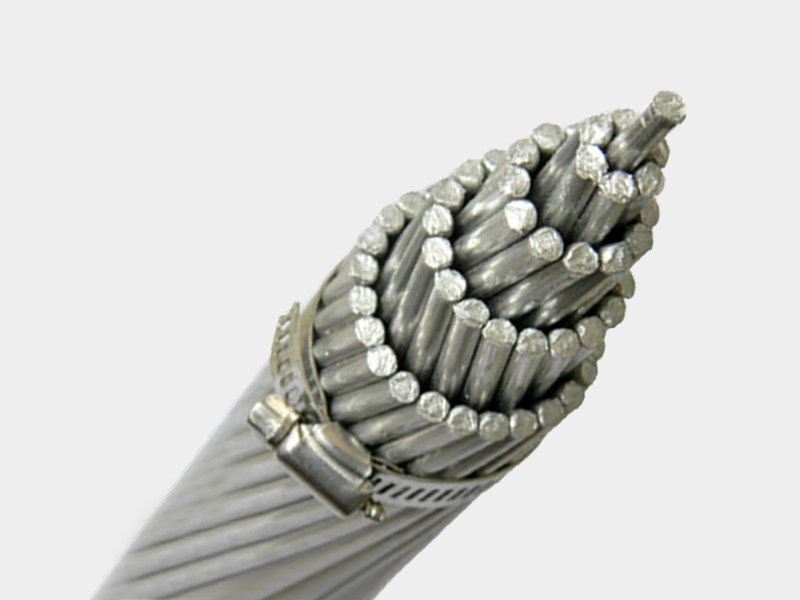
AAC — All Aluminum Conductor (IEC 61089) is a concentric-lay stranded overhead conductor manufactured entirely from high-purity electrolytic aluminium (minimum 99.7% Al, 1350 alloy) in the hard-drawn temper. Standardised under IEC 61089 — "Round wire concentric lay overhead electrical stranded conductors" — AAC is one of the most widely specified bare overhead conductors globally, used for low, medium, and high voltage overhead transmission and distribution lines wherever high electrical conductivity and superior corrosion resistance are the primary design requirements.
The all-aluminium construction delivers a conductivity of 61% IACS — substantially higher than ACSR for the same cross-section — making AAC the conductor of choice in urban and suburban distribution networks where span lengths are moderate and the superior current-carrying capacity of a high-conductivity aluminium section outweighs the lower tensile strength compared to steel-reinforced alternatives. The absence of a bimetallic steel core also eliminates the galvanic corrosion risk at the aluminium-steel interface, making AAC particularly preferred in coastal and high-humidity environments where ACSR performance can deteriorate over time.
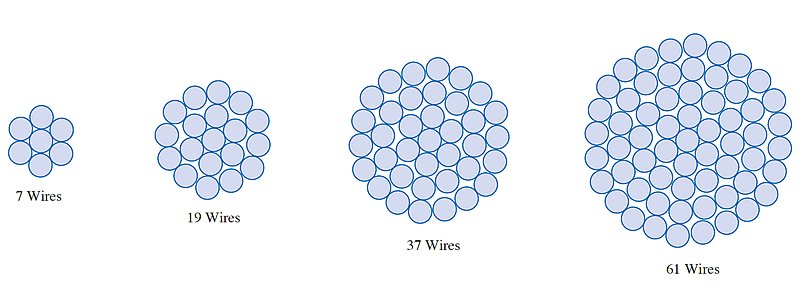
Available in nominal cross-sections from 10 mm² to 1500 mm², with stranding configurations from 7 wires (small sizes) up to 91 wires (large sizes). Conductor shape is circular concentric lay; sectoral profiles available on request for bundled conductor applications.
Outer Layer — Hard-drawn 1350 aluminium wires, concentric lay
Inner Layers — Successive concentric wire layers, each wound in opposite direction
Core Wire — Single hard-drawn aluminium wire (7-wire) or centre layer (19/37/61/91-wire)
No Steel Core — Pure aluminium construction, no bimetallic interface
Technical Specifications
Basic Parameters
| Standard | IEC 61089 — Round wire concentric lay overhead electrical stranded conductors |
|---|---|
| Conductor Material | Hard-drawn aluminium alloy 1350 (99.7% minimum purity, electrolytically refined) |
| Temper | Hard-drawn (H19 / IEC designation A1) |
| Conductivity | 61% IACS (≥ 34.5 m/Ω·mm²) |
| Lay Construction | Concentric lay stranded, circular cross-section; adjacent layers wound in opposite directions |
| Nominal Cross-Section Range | 10 mm² to 1500 mm² |
| Stranding | 7 wires (10–63 mm²) / 19 wires (100–250 mm²) / 37 wires (315–560 mm²) / 61 wires (630–1000 mm²) / 91 wires (1120–1500 mm²) |
| Surface Finish | Bare (uncoated); grease-filled available on request |
| Max. Conductor Temperature | 80 °C (continuous operation per IEC 61089 current rating basis) |
| Coefficient of Linear Expansion | 23 × 10⁻⁶ /°C |
| Modulus of Elasticity | 55–65 GPa (hard-drawn aluminium) |
| Density | 2.703 g/cm³ |
| Packaging | Wooden or steel drum; standard lengths 500 m / 1000 m; custom lengths available |
Full Parameter Table — IEC 61089 AAC (10–1500 mm²)
| Nominal Area (mm²) | Stranding (No.×mm) | Overall Ø (mm) | Weight (kg/km) | Rated Tensile Strength (kN) | DC Resistance (Ω/km, 20°C) | Current Rating* (A) |
|---|---|---|---|---|---|---|
| 10 | 7/1.35 | 4.05 | 27.4 | 1.95 | 2.8633 | 62 |
| 16 | 7/1.71 | 5.13 | 43.8 | 3.04 | 1.7896 | 84 |
| 25 | 7/2.13 | 6.39 | 68.4 | 4.50 | 1.1453 | 110 |
| 40 | 7/2.70 | 8.10 | 109.4 | 6.80 | 0.7158 | 147 |
| 63 | 7/3.39 | 10.17 | 172.3 | 10.39 | 0.4545 | 195 |
| 100 | 19/2.59 | 12.95 | 274.8 | 17.00 | 0.2877 | 259 |
| 125 | 19/2.89 | 14.45 | 343.6 | 21.25 | 0.2302 | 297 |
| 160 | 19/3.27 | 16.35 | 439.8 | 26.40 | 0.1798 | 345 |
| 200 | 19/3.66 | 18.30 | 549.7 | 32.00 | 0.1439 | 396 |
| 250 | 19/4.09 | 20.45 | 687.1 | 40.00 | 0.1151 | 454 |
| 315 | 37/3.29 | 23.03 | 867.9 | 51.97 | 0.0916 | 522 |
| 400 | 37/3.71 | 25.97 | 1102.0 | 64.00 | 0.0721 | 603 |
| 450 | 37/3.94 | 27.58 | 1239.8 | 72.00 | 0.0641 | 647 |
| 500 | 37/4.15 | 29.05 | 1377.6 | 80.00 | 0.0577 | 688 |
| 560 | 37/4.39 | 30.73 | 1542.9 | 89.60 | 0.0515 | 736 |
| 630 | 61/3.63 | 32.67 | 1738.3 | 100.80 | 0.0458 | 789 |
| 710 | 61/3.85 | 34.65 | 1959.1 | 113.60 | 0.0407 | 845 |
| 800 | 61/4.09 | 36.81 | 2207.4 | 128.00 | 0.0361 | 905 |
| 900 | 61/4.33 | 38.97 | 2483.3 | 144.00 | 0.0321 | 967 |
| 1000 | 61/4.57 | 41.13 | 2759.2 | 160.00 | 0.0289 | 1026 |
| 1120 | 91/3.96 | 43.56 | 3093.5 | 179.20 | 0.0258 | 1091 |
| 1250 | 91/4.18 | 45.98 | 3452.6 | 200.00 | 0.0231 | 1157 |
| 1400 | 91/4.43 | 48.73 | 3866.9 | 224.00 | 0.0207 | 1226 |
| 1500 | 91/4.58 | 50.38 | 4143.1 | 240.00 | 0.0193 | 1270 |
Key Features & Technical Advantages
High Electrical Conductivity — 61% IACS
AAC 1350 aluminium achieves 61% IACS conductivity — the highest of any bare overhead aluminium conductor type. For a given cross-section, AAC carries more current than ACSR (which sacrifices some aluminium area to the steel core) and is specified wherever maximum current capacity per mm² is the design objective.
Superior Corrosion Resistance
The natural aluminium oxide layer (Al₂O₃) that forms instantly on exposed aluminium provides excellent self-passivating corrosion protection. Without a bimetallic steel-aluminium interface, AAC eliminates the galvanic corrosion mechanism that can degrade ACSR in coastal, tropical, and industrial pollution environments over decades of service.
Lightweight — Low Dead Load
Aluminium density (2.703 g/cm³) is approximately one-third of copper (8.89 g/cm³) and lower than steel (7.85 g/cm³). AAC conductors impose lower dead loads on towers, poles, and hardware — enabling longer spans or lighter support structures compared to equivalent-capacity copper conductors.
Concentric Lay Construction
Alternate-direction layer winding produces a mechanically stable, self-locking construction that resists unravelling at cut ends and maintains circular cross-section under tension. The concentric lay also distributes tensile load uniformly across all wires — no single wire carries disproportionate stress.
Wide Size Range — 10 to 1500 mm²
24 standard sizes from 10 mm² (rural LV distribution) to 1500 mm² (high-capacity EHV transmission) — a single product family covers the complete range of overhead line applications from 11 kV rural feeders to 500 kV bulk transmission circuits.
Global IEC Standard Acceptance
IEC 61089 is the most widely adopted international bare conductor standard — specified by utilities across Europe, Asia, Africa, and the Middle East. IEC-certified AAC is accepted without modification in project specifications across more countries than any other conductor standard.
AAC vs ACSR vs AAAC — Selection Guide
| Parameter | AAC (IEC 61089) | ACSR (IEC 61089) | AAAC (IEC 61089) |
|---|---|---|---|
| Conductor material | Pure aluminium 1350 | Aluminium 1350 + steel core | Aluminium alloy 6201 |
| Conductivity | 61% IACS (highest) | Lower (steel core reduces Al area) | 52.5% IACS |
| Tensile strength | Moderate | High (steel core) | High (alloy temper) |
| Corrosion resistance | Excellent (no bimetallic) | Good (galvanic risk at interface) | Excellent (no steel) |
| Weight | Light | Heavier (steel core) | Light |
| Best for | Urban/coastal, short-medium spans | Long spans, high mechanical load | Long spans, coastal, no steel |
Certifications & Standards
Typical Applications
Urban Distribution Networks
LV and MV overhead lines in cities and towns where short spans and high current capacity make AAC's conductivity advantage decisive over ACSR.
Suburban & Residential Feeders
11 kV and 33 kV distribution feeders in suburban areas — standard conductor for utility distribution networks across Europe, Asia, and Africa.
Coastal & Marine Environments
Salt-laden air and marine humidity accelerate galvanic corrosion in ACSR. AAC's single-metal construction provides superior long-term reliability in coastal regions.
Tropical High-Humidity Areas
High annual rainfall and humidity environments where corrosion protection is the primary long-term reliability concern for overhead infrastructure.
High-Voltage Transmission
Large cross-section AAC (315–1500 mm²) used in HV and EHV transmission where high conductivity minimises resistive losses at sustained high current loading.
Industrial Zone Distribution
Heavy industrial areas with high fault current levels — AAC's high conductivity ensures minimum resistive losses and voltage drop in demanding industrial feeders.
Bundled Conductor Systems
Twin or quad bundled AAC configurations for EHV lines — reduces corona discharge and skin effect resistance at 220 kV and above.
Railway Electrification
Contact wire return conductors and feeder cables for AC and DC railway electrification systems where low resistance and light weight are critical.