
Product Overview
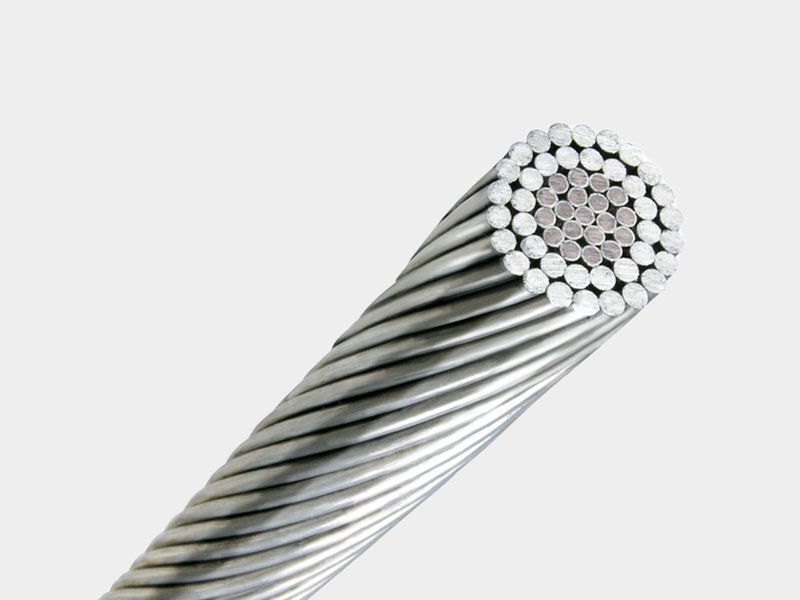
ACSR — Aluminum Conductor Steel Reinforced (IEC 61089) is a composite overhead conductor consisting of a high-tensile galvanised steel core surrounded by one or more concentric layers of hard-drawn 1350-H19 aluminium wires, manufactured to IEC 61089 — Round wire concentric lay overhead electrical stranded conductors. The IEC 61089 material designation is AL1/ST1A — Class A1 aluminium (61% IACS, 1350-H19) over Class ST1A steel (minimum tensile strength 1270 MPa, hot-dip galvanised). ACSR is the most widely used bare overhead conductor type in the world, deployed on overhead transmission and distribution networks across every inhabited continent.
The fundamental engineering principle of ACSR is the division of function between two materials: the aluminium carries virtually all the electrical current (steel contributes less than 3% of current-carrying capacity due to its much lower conductivity), while the steel core carries the mechanical tensile load — enabling the conductor to span distances and withstand wind, ice, and temperature loading that pure aluminium conductors cannot achieve at equivalent cross-section. This allows transmission line designers to optimise span length, tower height, and tower spacing independently of conductor ampacity — the defining advantage of ACSR over all-aluminium conductor types.
IEC 61089 ACSR is designated by its aluminium/steel cross-section ratio (e.g. 50/8, 95/16, 150/25, 240/40 mm²) and its full IEC designation (e.g. 149-AL1/24-ST1A for the 150/25 size), providing an unambiguous specification reference for international project procurement. Available in configurations from 25/4 mm² to 400/50 mm² and above, covering the complete range from rural 11 kV distribution through 500 kV bulk transmission.
Outer Aluminium Layers — Hard-drawn 1350-H19 (AL1), right-hand outer layer, carries electrical current
Inner Aluminium Layer — First aluminium layer wound in opposite direction to outer
Galvanised Steel Core — Class ST1A high-tensile steel wire(s), hot-dip zinc galvanised, carries mechanical load
IEC Designation — [Al area]-AL1/[St area]-ST1A (e.g. 149-AL1/24-ST1A for 150/25)
Highest Tensile Strength
High-tensile galvanised steel core (≥ 1270 MPa UTS per IEC 61089) provides the highest breaking load of any aluminium conductor family — enabling the longest spans, greatest ice/wind loading resistance, and lowest sag at maximum operating temperature.
Long-Span Capability
ACSR's steel-reinforced strength enables span lengths of 400–600 m for standard distribution lines and 800–1500 m for major river crossings and mountain approaches — distances far beyond the capability of AAC or AAAC on the same pole/tower configuration.
Tunable Al/St Ratio
The aluminium-to-steel cross-section ratio can be selected to optimise for different priorities: high Al/St ratios (e.g. 400/50 — predominantly aluminium) maximise conductivity; low Al/St ratios (e.g. 25/4 — small aluminium, large steel) maximise mechanical strength for shield wire and short span applications.
61% IACS Aluminium Conductivity
The aluminium component is 1350-H19 at 61% IACS — the same high-conductivity aluminium used in AAC. Only the steel core area reduces the effective conductor cross-section available for current-carrying, making high Al/St ratio ACSR the most current-efficient ACSR configurations.
Hot-Dip Galvanised Steel Core
Class ST1A steel wires are hot-dip zinc galvanised per IEC 61089 — the zinc coating provides cathodic protection against corrosion of the steel core even if the coating is locally damaged. Grease-filled (greased core and/or interstitial grease) variants available for marine and industrial pollution environments.
Global Standard — Universally Accepted
IEC 61089 ACSR is specified by utilities on every continent. The AL1/ST1A designation and mm² Al/St notation provide unambiguous procurement specifications accepted in Europe, Asia, Africa, the Middle East, and Latin America without conversion or recalculation.
Technical Specifications
Basic Parameters
| Standard | IEC 61089 — Round wire concentric lay overhead electrical stranded conductors |
|---|---|
| IEC Material Designation | AL1/ST1A — Class A1 aluminium (1350-H19, 61% IACS) + Class ST1A galvanised steel |
| Aluminium Wire | Hard-drawn 1350-H19; conductivity 61% IACS; tensile strength 160–175 MPa |
| Steel Core Wire | High-tensile galvanised steel (Class ST1A); min. tensile strength 1270 MPa; hot-dip zinc galvanised per IEC 61089 |
| Aluminium Conductivity | 61% IACS (aluminium only; effective conductor conductivity reduced by steel core area) |
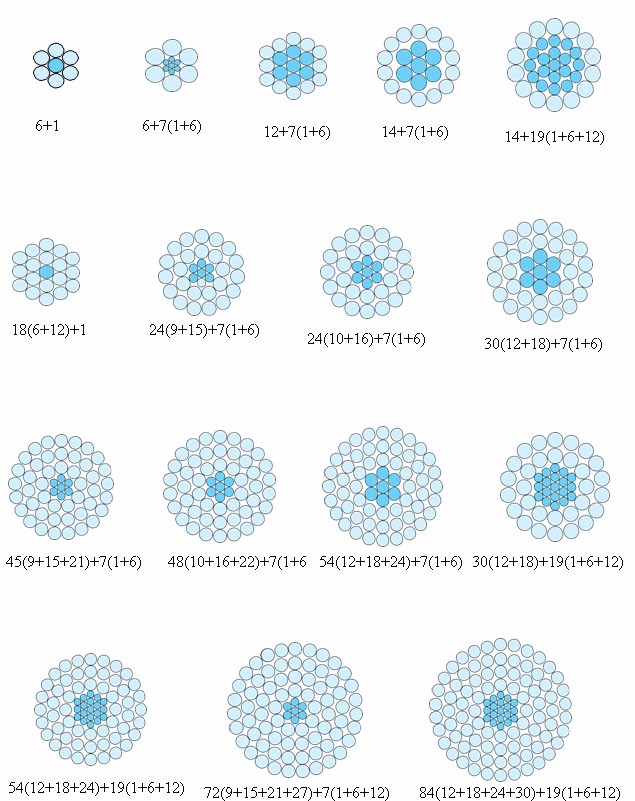
| Standard Al/St Ratios | 6/1 (6 Al wires / 1 St wire, 6× Al/St area) and 26/7 (26 Al / 7 St, ~6× area) — most common; others available |
| Outer Layer | Right-hand lay aluminium; adjacent layers wound in alternating directions |
| Max. Continuous Temperature | 80 °C (standard); high-temperature grades (HTLS) available to 150°C+ |
| Coefficient of Linear Expansion (composite) | 18.9–19.3 × 10⁻⁶ /°C (varies with Al/St ratio) |
| Core Protection Option | Bare (standard); Class A grease-filled; Class B heavy-duty grease for marine/industrial environments |
| Packaging | Wooden or steel drum; 500 m / 1000 m standard; custom lengths available |
Full Parameter Table — IEC 61089 ACSR (AL1/ST1A)
| Al Area (mm²) | St Area (mm²) | Total (mm²) | Al Stranding (No./mm) | St Stranding (No./mm) | Core Ø (mm) | Overall Ø (mm) | Weight (kg/km) | Rated Strength (kN) | DC Resistance (Ω/km, 20°C) |
|---|---|---|---|---|---|---|---|---|---|
| 16 | 2.67 | 18.7 | 6/1.84 | 1/1.84 | 1.84 | 5.53 | 64.6 | 6.08 | 1.7934 |
| 25 | 4.17 | 29.2 | 6/2.30 | 1/2.30 | 2.30 | 6.91 | 100.9 | 9.13 | 1.1478 |
| 40 | 6.67 | 46.7 | 6/2.91 | 1/2.91 | 2.91 | 8.74 | 161.5 | 14.40 | 0.7174 |
| 63 | 10.5 | 73.5 | 6/3.66 | 1/3.66 | 3.66 | 11.00 | 254.4 | 21.63 | 0.4555 |
| 100 | 16.7 | 117 | 6/4.61 | 1/4.61 | 4.61 | 13.80 | 403.8 | 34.33 | 0.2869 |
| 125 | 6.94 | 132 | 18/2.97 | 1/2.97 | 2.97 | 14.90 | 397.9 | 29.17 | 0.2304 |
| 125 | 20.4 | 145 | 26/2.47 | 7/1.92 | 5.77 | 15.70 | 503.9 | 45.69 | 0.2310 |
| 160 | 8.89 | 169 | 18/3.36 | 1/3.36 | 3.36 | 16.80 | 508.3 | 36.18 | 0.1800 |
| 160 | 26.1 | 186 | 26/2.80 | 7/2.18 | 6.53 | 17.70 | 644.9 | 57.69 | 0.1805 |
| 200 | 11.1 | 211 | 18/3.76 | 1/3.76 | 3.76 | 18.80 | 636.7 | 44.22 | 0.1440 |
| 200 | 32.6 | 233 | 26/3.13 | 7/2.43 | 7.30 | 19.80 | 806.2 | 70.13 | 0.1444 |
| 250 | 24.6 | 275 | 22/3.80 | 7/2.11 | 6.34 | 21.60 | 880.6 | 68.72 | 0.1154 |
| 250 | 40.7 | 291 | 26/3.50 | 7/2.72 | 8.16 | 22.20 | 1007.7 | 87.67 | 0.1155 |
| 315 | 21.8 | 337 | 45/2.99 | 7/1.99 | 5.97 | 23.90 | 1039.3 | 79.03 | 0.0917 |
| 315 | 51.3 | 366 | 26/3.93 | 7/3.05 | 9.16 | 24.90 | 1269.7 | 106.83 | 0.0917 |
| 400 | 27.7 | 428 | 45/3.36 | 7/2.24 | 6.73 | 26.90 | 1320.1 | 98.36 | 0.0722 |
| 400 | 51.9 | 452 | 54/3.07 | 7/3.07 | 9.21 | 27.60 | 1510.3 | 123.04 | 0.0723 |
| 450 | 31.1 | 481 | 45/3.57 | 7/2.38 | 7.14 | 28.50 | 1485.2 | 107.47 | 0.0642 |
| 450 | 58.3 | 508 | 54/3.26 | 7/3.26 | 9.77 | 29.30 | 1699.1 | 138.42 | 0.0643 |
| 500 | 34.6 | 535 | 45/3.76 | 7/2.51 | 7.52 | 30.10 | 1650.2 | 119.41 | 0.0578 |
| 500 | 64.8 | 565 | 54/3.43 | 7/3.43 | 10.30 | 30.90 | 1887.9 | 153.80 | 0.0578 |
| 560 | 38.7 | 599 | 45/3.98 | 7/2.65 | 7.96 | 31.80 | 1848.2 | 133.74 | 0.0516 |
| 560 | 70.9 | 631 | 54/3.63 | 19/2.18 | 10.90 | 32.70 | 2103.4 | 172.59 | 0.0516 |
| 630 | 43.6 | 674 | 45/4.22 | 7/2.81 | 8.44 | 33.80 | 2079.2 | 150.45 | 0.0459 |
| 630 | 79.8 | 710 | 54/3.85 | 19/2.31 | 11.60 | 34.70 | 2366.3 | 191.77 | 0.0459 |
| 710 | 49.1 | 759 | 45/4.48 | 7/2.99 | 8.96 | 35.90 | 2343.2 | 169.56 | 0.0407 |
| 710 | 89.9 | 800 | 54/4.09 | 19/2.45 | 12.30 | 36.80 | 2666.8 | 216.12 | 0.0407 |
| 800 | 34.6 | 835 | 72/3.76 | 7/2.51 | 7.52 | 37.60 | 2480.2 | 167.41 | 0.0361 |
| 800 | 66.7 | 867 | 84/3.48 | 7/3.48 | 10.40 | 38.30 | 2732.7 | 205.33 | 0.0362 |
| 800 | 101 | 901 | 54/4.34 | 19/2.61 | 13.00 | 39.10 | 3004.9 | 243.52 | 0.0362 |
| 900 | 38.9 | 939 | 72/3.99 | 7/2.66 | 7.98 | 39.90 | 2790.2 | 188.33 | 0.0321 |
| 900 | 75.0 | 975 | 84/3.69 | 7/3.69 | 11.10 | 40.60 | 3074.2 | 226.50 | 0.0322 |
| 1000 | 43.2 | 1043 | 72/4.21 | 7/2.80 | 8.41 | 42.10 | 3100.3 | 209.26 | 0.0259 |
| 1120 | 47.3 | 1167 | 72/4.45 | 19/1.78 | 8.90 | 44.50 | 3464.9 | 234.53 | 0.0258 |
| 1120 | 91.2 | 1211 | 84/4.12 | 19/2.47 | 12.40 | 45.30 | 3811.5 | 283.17 | 0.0258 |
| 1250 | 52.8 | 1303 | 72/4.70 | 19/1.88 | 9.40 | 47.00 | 3867.1 | 261.75 | 0.0231 |
| 1250 | 102 | 1352 | 84/4.35 | 19/2.61 | 13.10 | 47.90 | 4253.9 | 316.04 | 0.0232 |
Common ACSR Stranding Configurations
| Configuration | Al Wires | St Wires | Al/St Area Ratio | Typical Size Range | Characteristic |
|---|---|---|---|---|---|
| 6/1 | 6 | 1 | ≈ 6× | 25–50 mm² | Small distribution sizes; circular cross-section |
| 26/7 | 26 | 7 | ≈ 6× | 70–500 mm² | Most common HV transmission configuration |
| 30/7 | 30 | 7 | ≈ 6× | 150–400 mm² | Higher Al content variant of 26/7 |
| 54/7 | 54 | 7 | ≈ 8× | 300–500 mm² | Very high Al/St ratio; maximum conductivity |
| 45/7 | 45 | 7 | ≈ 4× | 300 mm² | Higher steel content; enhanced mechanical strength |
| 12/7 | 12 | 7 | ≈ 1.7× | 95–150 mm² | Very high steel ratio; earth wire / shield wire applications |
Key Features & Technical Advantages
Steel Core — Unmatched Tensile Strength
ST1A steel (≥ 1270 MPa UTS) provides a breaking load 5–8× higher than the aluminium component alone. For a 240/40 ACSR, the steel core provides over 60% of the total rated tensile strength from just 14% of the total conductor cross-section — the quintessential example of composite material efficiency in electrical engineering.
Minimum Sag Under Maximum Load
Low creep rate and high elastic modulus of the steel core minimise conductor sag under elevated temperature and heavy mechanical loading. On long-span lines, ACSR maintains ground clearance at maximum operating temperature where all-aluminium conductors would sag beyond permissible limits without taller towers.
Adjustable Al/St Ratio for Design Optimisation
Selecting a higher Al/St ratio (more aluminium, less steel) increases ampacity and reduces line losses; selecting a lower ratio increases mechanical strength for difficult terrain. This design freedom — unique to ACSR — allows transmission engineers to optimise the conductor for the specific span lengths, loading conditions, and ampacity requirements of each line section.
Hot-Dip Galvanised Steel — Corrosion Protection
Zinc galvanising provides cathodic protection: the zinc corrodes preferentially, protecting the underlying steel even at local coating damage points. Standard galvanising (Class ST1A) suits most environments; heavy galvanising or grease filling provides additional protection for coastal, marine, and high-pollution industrial zones.
Ice & Wind Loading Resistance
High rated tensile strength allows ACSR to withstand extreme combined ice and wind loading that would break or permanently stretch all-aluminium conductors. Mandatory for overhead lines in ice-prone mountain regions, high-wind coastal areas, and sub-arctic climates where conductor loading far exceeds everyday operating conditions.
HTLS Upgrade Path
Standard ACSR can be upgraded to High Temperature Low Sag (HTLS) variants — such as ACSR/TW, ACSS, or GTACSR — that operate at 150°C+ without increased sag, doubling line capacity on the same towers. The ACSR cross-section and hardware are retained; only the conductor is replaced in a reconductoring upgrade.
ACSR vs AAC vs AAAC — When to Choose ACSR
| Design Requirement | ACSR | AAC | AAAC |
|---|---|---|---|
| Span > 300 m | ✅ Best choice | ❌ Excessive sag | ✅ Suitable |
| Heavy ice / wind loading | ✅ Best choice | ❌ Insufficient strength | ⚠️ Marginal |
| Coastal / marine environment | ⚠️ Galvanic risk at Al-St interface | ✅ No bimetallic risk | ✅ Best choice |
| Maximum conductivity | ⚠️ Steel reduces effective Al area | ✅ Best (61% IACS, all Al) | ⚠️ 52.5% IACS |
| Long-term tropical / humid service | ⚠️ Core corrosion risk | ✅ No steel to corrode | ✅ Best choice |
| Very long spans (>500 m) | ✅ Best choice | ❌ Not suitable | ⚠️ Limited |
| Most economical for HV transmission | ✅ Globally standard | ⚠️ Limited span | ✅ Competitive for coastal |
Certifications & Standards
Typical Applications
HV & EHV Transmission Lines
66 kV to 500 kV bulk transmission — large cross-section ACSR (240/40 to 400/65 mm²) on long-span lattice tower lines is the global standard for high-voltage transmission.
Urban & Suburban Distribution
11 kV to 33 kV overhead distribution feeders — medium cross-section ACSR (50/8 to 150/25 mm²) on wood pole structures is the dominant conductor type in developing-world distribution networks.
River & Valley Crossings
Long-span crossings of rivers, lakes, and valleys where spans of 500–1500 m require the maximum tensile strength that only ACSR can provide at economical conductor weight.
Mountain & Difficult Terrain
Lines crossing mountainous terrain with long spans, steep approach angles, and exposure to high winds and ice loading — conditions that make ACSR the only viable all-weather conductor choice.
Ice-Load Zones
Sub-arctic and alpine lines subject to heavy radial ice accretion — ACSR's steel core provides the reserve tensile strength to prevent conductor breakage under extreme ice load conditions.
Rural Long-Span Distribution
Rural 11–33 kV feeders with spans of 200–400 m across flat agricultural terrain — ACSR enables fewer poles per km and lower line construction cost than AAC.
Earth Wire / Shield Wire
Low Al/St ratio ACSR (12/7 configuration, e.g. 95/55 mm²) used as overhead earth wire — low conductivity and very high tensile strength suit this lightning shielding application.
Line Reconductoring
Replacing aged AAC or smaller ACSR on existing tower lines — ACSR's superior strength allows larger cross-sections and higher ampacity on the same towers without structural upgrades.