
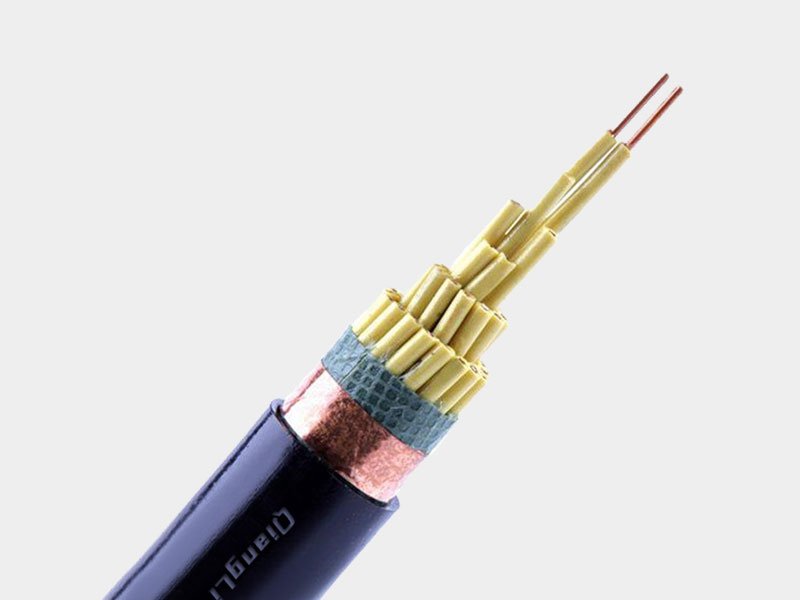
Product Overview
CVVS Control Cable is a copper conductor, PVC insulated, PVC inner sheathed, annealed copper tape shielded, PVC outer sheathed multi-core control cable rated at 450/750V, manufactured to KS C IEC 60502-1 — the Korean Standard equivalent of IEC 60502-1. The "-S" suffix designates the annealed copper tape shield wound helically around the assembled and sheathed cores — providing electromagnetic shielding (EMI/RFI interference rejection) for control, instrumentation, and supervisory circuits operating in electrically noisy industrial environments.
The copper tape shield is the defining feature of CVVS versus unshielded CVV. In industrial environments containing variable-frequency drives (VFDs), large motors, welding equipment, switching power supplies, and high-current bus bars, unshielded control cables pick up electromagnetic interference that corrupts low-level analogue signals, causes false digital I/O triggering, and disrupts SCADA communication. The CVVS copper tape shield — connected to earth at one end (single-end earth for electrostatic shielding) — intercepts and diverts these induced voltages to earth before they reach the circuit conductors, maintaining signal integrity across the full cable length.
CVVS is specified for supervisory electrical equipment, station control circuits, and instrumentation — suitable for indoor and outdoor installation in wet or dry locations, in conduit, duct, cable trench, and cable tray. Available in 2 to 7 cores and conductor sizes from 1.0 mm² to 6 mm².
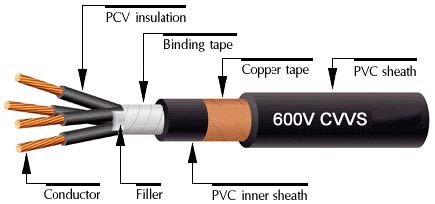
PVC Outer Sheath — Black PVC, weather and chemical resistant
Copper Tape Shield (–S) — Annealed copper tape, helically applied, EMI/RFI shielding
PVC Inner Sheath — Black PVC bedding over cabled cores
Numbered Black Cores — White printed numbering on black PVC insulation, concentric stranded copper
Annealed Copper Tape Shield
Helically wound annealed copper tape provides high-coverage electrostatic shielding — intercepting capacitively coupled interference from adjacent high-voltage conductors and switching equipment before it reaches the signal conductors. Copper tape achieves ≥95% shield coverage, compared to ~85% typical for braided shields of the same material weight.
KS C IEC 60502-1 — Korean Standard
KS C IEC 60502-1 is the Korean Industrial Standard (KS) adoption of IEC 60502-1 — accepted in Korea and internationally for projects referencing either KS or IEC control cable standards. CVVS is widely used across South Korean industrial facilities, power plants, and export projects from Korean contractors.
Four Cable Type Family
The CVV family covers five insulation/sheath combinations (CVV, CEV, CCV, CEE, CCE) for different temperature and chemical resistance requirements. Adding the -S shield suffix to any base type gives the shielded variant: CVVS, CEVS, CCVS, etc. — a systematic cable family covering all temperature and EMI protection combinations.
White Numbered Identification on Black Insulation
White sequential numbers printed on black insulation provide high-contrast, permanent core identification. This colour scheme (black insulation + white print) maintains legibility far longer than colour-coded insulation systems under UV exposure, oil contamination, and thermal ageing — critical for cables that must be traced and identified decades after installation.
Unarmoured — Flexible Installation
Without the armour layer of CVVS22 variants, CVVS is more flexible and lighter than armoured equivalents — easier to pull through conduit and cable tray, and suitable for installation where mechanical protection is provided by the raceway rather than the cable itself. Minimum bending radius is lower than armoured cables of equivalent cross-section.
Four Shield Type Options
Beyond the standard copper tape (-S), three alternative shield types are available: aluminium-laminate tape with drain wire (-SLA), copper wire braid (-SB), and copper tape + steel tape combined (-SCF) — each optimised for different frequency ranges of interference and installation requirements. The base CVVS-S is the most cost-effective for 50/60 Hz power frequency interference.
Technical Specifications
CVV Cable Family — Base Type Selection
| Symbol | Max. Conductor Temp. (°C) | Insulation | Sheath | Application |
|---|---|---|---|---|
| CVV(-S) | 60 | PVC | PVC | General use — most common; add -S for copper tape shielded version (CVVS) |
| CEV(-S) | 75 | Polyethylene | PVC | Higher temperature service; add -S for CEVS variant |
| CCV(-S) | 90 | XLPE | PVC | High temperature — 90°C continuous; add -S for CCVS |
| CEE(-S) | 75 | Polyethylene | Polyethylene (Black) | Chemical and oil resistance; PE outer sheath |
| CCE(-S) | 90 | XLPE | Polyethylene (Black) | High temperature + chemical resistance |
Shield Type Options (applicable to all base types)
| Shield Type | Symbol | Construction | Best For |
|---|---|---|---|
| Annealed copper tape | -S | Copper tape helically wound | General EMI shielding at power frequency — most common, this product |
| Al-laminate + drain wire | -SLA | Aluminium foil tape + earth drain wire | Lighter weight; drain wire simplifies shield earthing at termination |
| Copper wire braid | -SB | Annealed copper wire braid | High-frequency RF shielding; more flexible than tape shield |
| Cu tape + steel tape | -SCF | Copper tape over-wrapped with steel tape | Combined EMI shielding + limited mechanical protection |
Basic Technical Parameters
| Standard | KS C IEC 60502-1 |
|---|---|
| Rated Voltage | 450/750V |
| Conductor | Concentric stranded soft annealed copper (7/0.40 mm for 1 mm²; 7/0.50 for 1.5 mm²; 7/0.67 for 2.5 mm²; 7/0.85 for 4 mm²; 7/1.04 for 6 mm²) |
| Insulation | PVC — black, with white sequential number printed on surface |
| Inner Sheath | PVC — black |
| Shield | Annealed copper tape (-S), helically applied |
| Outer Sheath | PVC — black |
| Core Counts | 2 / 3 / 4 / 5 / 6 / 7 |
| Conductor Sizes | 1.0 / 1.5 / 2.5 / 4 / 6 mm² |
| Max. Conductor Temperature | +60 °C (CVV-type PVC insulation) |
| Min. Insulation Resistance | 0.0078 ~ 0.0135 GΩ·km (at 70°C, varies by cross-section) |
| Max. DC Resistance | 18.1 Ω/km (1 mm²) to 3.08 Ω/km (6 mm²) at 20°C |
| Shield Earth Connection | Single-end earth (electrostatic shielding); both ends for low-impedance path |
| Min. Bending Radius | 6 × overall diameter (unarmoured) |
| Packaging | Wooden drum; standard lengths 500 m / 1000 m; custom lengths available |
Full Parameter Table — CVVS (KS C IEC 60502-1)
| Part No. | Cores | Section (mm²) | Conductor (No./mm) | Insulation (mm) | Inner Sheath (mm) | Outer Sheath (mm) | Overall Ø (mm) | DC Resistance (Ω/km, 20°C) | Min. Insulation Resistance (GΩ·km at 70°C) | Weight (kg/km) |
|---|---|---|---|---|---|---|---|---|---|---|
| CVVS-2C1.00SQ | 2 | 1.0 | 7/0.40 | 0.8 | 1.0 | 1.8 | 13 | 18.1 | 0.0135 | 205 |
| CVVS-2C1.50SQ | 2 | 1.5 | 7/0.50 | 0.8 | 1.0 | 1.8 | 14 | 12.1 | 0.0115 | 230 |
| CVVS-2C2.50SQ | 2 | 2.5 | 7/0.67 | 0.8 | 1.0 | 1.8 | 15 | 7.41 | 0.0093 | 280 |
| CVVS-2C4.00SQ | 2 | 4.0 | 7/0.85 | 1.0 | 1.0 | 1.8 | 17 | 4.61 | 0.0092 | 375 |
| CVVS-2C6.00SQ | 2 | 6.0 | 7/1.04 | 1.0 | 1.0 | 1.8 | 18.5 | 3.08 | 0.0078 | 450 |
| CVVS-3C1.00SQ | 3 | 1.0 | 7/0.40 | 0.8 | 1.0 | 1.8 | 13.5 | 18.1 | 0.0135 | 225 |
| CVVS-3C1.50SQ | 3 | 1.5 | 7/0.50 | 0.8 | 1.0 | 1.8 | 14.5 | 12.1 | 0.0115 | 260 |
| CVVS-3C2.50SQ | 3 | 2.5 | 7/0.67 | 0.8 | 1.0 | 1.8 | 15.5 | 7.41 | 0.0093 | 325 |
| CVVS-3C4.00SQ | 3 | 4.0 | 7/0.85 | 1.0 | 1.0 | 1.8 | 18 | 4.61 | 0.0092 | 445 |
| CVVS-3C6.00SQ | 3 | 6.0 | 7/1.04 | 1.0 | 1.0 | 1.8 | 19 | 3.08 | 0.0078 | 545 |
| CVVS-4C1.00SQ | 4 | 1.0 | 7/0.40 | 0.8 | 1.0 | 1.8 | 14.5 | 18.1 | 0.0135 | 260 |
| CVVS-4C1.50SQ | 4 | 1.5 | 7/0.50 | 0.8 | 1.0 | 1.8 | 15.5 | 12.1 | 0.0115 | 300 |
| CVVS-4C2.50SQ | 4 | 2.5 | 7/0.67 | 0.8 | 1.0 | 1.8 | 16.5 | 7.41 | 0.0093 | 385 |
| CVVS-4C4.00SQ | 4 | 4.0 | 7/0.85 | 1.0 | 1.0 | 1.8 | 19 | 4.61 | 0.0092 | 530 |
| CVVS-4C6.00SQ | 4 | 6.0 | 7/1.04 | 1.0 | 1.0 | 1.8 | 20.5 | 3.08 | 0.0078 | 660 |
| CVVS-5C1.00SQ | 5 | 1.0 | 7/0.40 | 0.8 | 1.0 | 1.8 | 15.5 | 18.1 | 0.0135 | 295 |
| CVVS-5C1.50SQ | 5 | 1.5 | 7/0.50 | 0.8 | 1.0 | 1.8 | 16.5 | 12.1 | 0.0115 | 345 |
| CVVS-5C2.50SQ | 5 | 2.5 | 7/0.67 | 0.8 | 1.0 | 1.8 | 18 | 7.41 | 0.0093 | 445 |
| CVVS-5C4.00SQ | 5 | 4.0 | 7/0.85 | 1.0 | 1.0 | 1.8 | 20.5 | 4.61 | 0.0092 | 620 |
| CVVS-5C6.00SQ | 5 | 6.0 | 7/1.04 | 1.0 | 1.0 | 1.8 | 22.5 | 3.08 | 0.0078 | 780 |
| CVVS-6C1.00SQ | 6 | 1.0 | 7/0.40 | 0.8 | 1.0 | 1.8 | 16.5 | 18.1 | 0.0135 | 320 |
| CVVS-6C1.50SQ | 6 | 1.5 | 7/0.50 | 0.8 | 1.0 | 1.8 | 17.5 | 12.1 | 0.0115 | 375 |
| CVVS-6C2.50SQ | 6 | 2.5 | 7/0.67 | 0.8 | 1.0 | 1.8 | 19 | 7.41 | 0.0093 | 490* |
| CVVS-6C4.00SQ | 6 | 4.0 | 7/0.85 | 1.0 | 1.0 | 1.8 | 22 | 4.61 | 0.0092 | 685 |
| CVVS-6C6.00SQ | 6 | 6.0 | 7/1.04 | 1.0 | 1.0 | 1.8 | 24 | 3.08 | 0.0078 | 865 |
| CVVS-7C1.00SQ | 7 | 1.0 | 7/0.40 | 0.8 | 1.0 | 1.8 | 16.5 | 18.1 | 0.0135 | 330 |
| CVVS-7C1.50SQ | 7 | 1.5 | 7/0.50 | 0.8 | 1.0 | 1.8 | 17.5 | 12.1 | 0.0115 | 395 |
| CVVS-7C2.50SQ | 7 | 2.5 | 7/0.67 | 0.8 | 1.0 | 1.8 | 19 | 7.41 | 0.0093 | 520 |
| CVVS-7C4.00SQ | 7 | 4.0 | 7/0.85 | 1.0 | 1.0 | 1.8 | 22 | 4.61 | 0.0092 | 730 |
| CVVS-7C6.00SQ | 7 | 6.0 | 7/1.04 | 1.0 | 1.0 | 1.8 | 24 | 3.08 | 0.0078 | 930 |
Key Features & Technical Advantages
Electrostatic Shielding — Signal Integrity
The annealed copper tape shield, earthed at one end, intercepts capacitively coupled interference (from adjacent high-voltage conductors, switching equipment, and inductive loads) and diverts it to earth before it reaches the signal conductors. For analogue signals (4–20 mA, 0–10 V, thermocouple, RTD), this shielding prevents the measurement errors that cause process control drift and spurious alarms in electrically noisy industrial installations.
≥95% Shield Coverage from Copper Tape
Helically applied copper tape achieves ≥95% shield coverage of the cable circumference — higher than typical copper braid (~85%) at the same shield material weight, and providing more effective low-frequency electrostatic shielding than aluminium-foil tape at the 50/60 Hz power frequency interference that dominates most industrial environments.
Black Insulation + White Numbering — Maximum Contrast
White sequential numbering on black PVC insulation provides the highest contrast for core identification — readable in poor light, under cable gland oil contamination, and after decades of thermal ageing that reduces the contrast of standard colour-coded cores. Essential for reliable maintenance identification in high-density instrumentation marshalling panels.
Unarmoured — Conduit and Tray Compatible
Without armour, CVVS is lighter and more flexible than CVVS22 (armoured) of the same core count — easier to pull through conduit, lay in cable tray, and route through cable entry glands. The raceway or conduit system provides mechanical protection; CVVS provides the EMI shielding. This division of function optimises both weight and protection level for raceway-based installations.
Four Shield Variants — Application Matched
-S (copper tape), -SLA (Al-laminate + drain wire), -SB (copper braid), -SCF (Cu + steel tape) cover the complete range of shielding requirements: -S for cost-effective low-frequency shielding; -SLA for lightest weight with drain wire earth; -SB for high-frequency RF applications; -SCF for combined EMI + mechanical protection without full armour.
KS C IEC 60502-1 — Korean Standard Compliance
KS C IEC 60502-1 certification enables procurement for Korean industrial projects, Korean contractor-led international projects, and IEC-specification international projects simultaneously — one cable satisfies the documentation requirements of all three specification environments without additional testing or certification.
Certifications & Standards
Typical Applications
Industrial Process Control
Analogue and digital I/O control wiring in manufacturing plants with VFDs, large motors, and welding equipment — CVVS shielding prevents interference from these sources corrupting control signals.
Power Plant Control & Instrumentation
Secondary control and instrumentation in coal, gas, and nuclear power plants — shielded control cable for protection relay, SCADA, and DCS secondary wiring in electrically noisy switchyard environments.
Substation Secondary Wiring
Protection relay, metering, and remote terminal unit (RTU) wiring in HV substations — copper tape shield prevents interference from high-voltage switching operations reaching sensitive relay and metering circuits.
Petrochemical & Process Plants
Instrument and control wiring in refineries, chemical plants, and LNG facilities — CVVS for analogue field device signals where EMI from pumps and motors must not corrupt process measurements.
PLC / DCS Signal Wiring
Shielded control cable for PLC analogue input modules and DCS field termination assemblies — shielding prevents common-mode interference from degrading 4–20 mA loop accuracy or causing 24V DC digital input noise triggering.
Railway & Traction Control
Control and signalling cable in railway environments — copper tape shield against the high electromagnetic interference generated by traction current in return rail and catenary systems.
Water Treatment & Pumping Stations
Control wiring at water treatment and sewage pumping stations — CVVS for instrumentation signals where VFD-driven pump motors generate significant EMI that must be excluded from measurement circuits.
Building Management Systems
BMS and HVAC control wiring in commercial buildings — CVVS in electrical risers and plant rooms where proximity to power cables creates electromagnetic interference affecting low-level BMS sensor signals.