
Product Overview
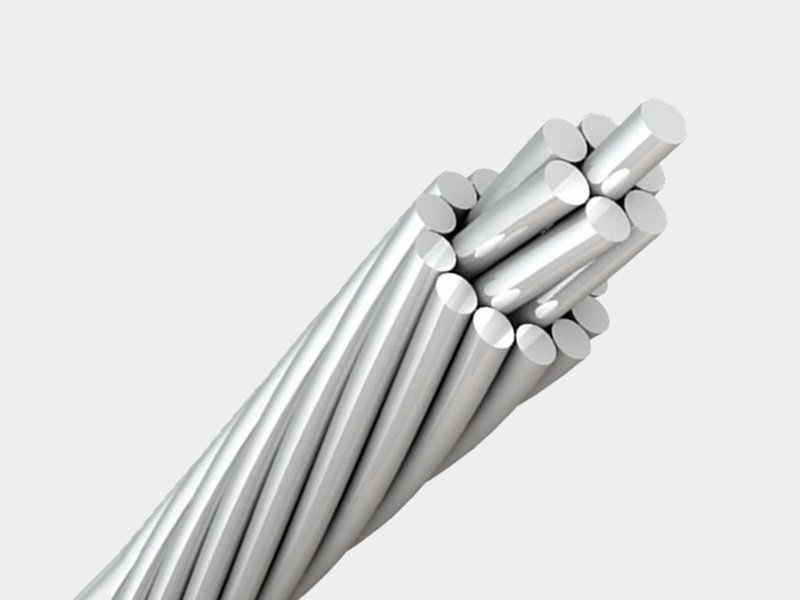
AAC — All Aluminum Conductor (DIN 48201 Part 5) is a concentric-lay stranded bare aluminium overhead conductor manufactured to the German national standard DIN 48201 Part 5 — "Stranded conductors for overhead lines; aluminium stranded conductors." Produced from hard-drawn 1350-series electrolytic aluminium (minimum 99.7% purity), it is the standard bare conductor specification for overhead transmission and distribution networks in Germany and throughout Central Europe, as well as countries across Africa, the Middle East, and Southeast Asia whose grid infrastructure was built to DIN engineering standards.
DIN 48201 Part 5 uses a pure numeric designation system — conductors are identified solely by their nominal cross-section in mm² (16, 25, 35, 50, 70, 95, 120, 150, 185, 240, 300, 400, 500 mm² and above) without code names. This makes the DIN system the most internationally unambiguous of all AAC standards: specifying "AAC 240 mm² DIN 48201-5" uniquely and precisely identifies the conductor across all geographies and languages. A distinctive feature of DIN 48201-5 is the dual stranding option at 50 mm² — both 7/3.00 mm (7-wire) and 19/1.80 mm (19-wire) constructions are specified, allowing utilities to select the more flexible 19-wire version for applications where bendability is important. Available from 16 mm² to 1000 mm² in 19 standard sizes.
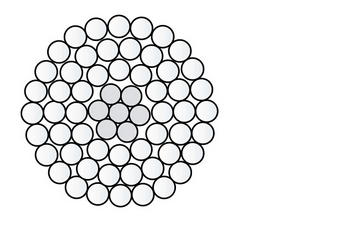
Outer Layer — Hard-drawn 1350 aluminium, right-hand concentric lay
Inner Layers — Successive layers in alternating lay directions
No Steel Core — All-aluminium construction, no bimetallic interface
Designation — Numeric mm² only (e.g. "Al 240" DIN 48201-5); no code names
DIN 48201 Part 5 — German & Central European Standard
Full compliance with the German national overhead conductor standard — accepted by German, Austrian, Swiss, and Central European utilities, and specified for infrastructure projects in DIN-standard markets across Africa, the Middle East, and Southeast Asia.
Pure Numeric mm² Designation
No code names — conductors are identified solely by nominal cross-section in mm². The most internationally unambiguous conductor designation system, eliminating the translation and conversion issues associated with flower names (ASTM) or celestial names (AS/NZS) in multilingual project documentation.
Dual Stranding at 50 mm²
DIN 48201-5 specifies both 7/3.00 mm (stiffer, standard overhead) and 19/1.80 mm (more flexible, for tight routing) constructions at the 50 mm² size — the only standard size with two alternative strandings, allowing project-specific selection based on installation requirements.
61% IACS Conductivity
Hard-drawn 1350 aluminium delivers 61% IACS conductivity — identical to all other AAC standards. Maximum current-carrying capacity for the cross-section, with the same electrical performance regardless of which national standard the conductor is manufactured to.
Includes Large Sizes to 1000 mm²
DIN 48201-5 extends to 1000 mm² (91/3.74 mm) — covering the full range from rural LV distribution (16–35 mm²) through standard MV/HV distribution (50–300 mm²) to high-capacity transmission (400–1000 mm²) within a single standard.
No Steel Core — Corrosion Resistant
All-aluminium construction eliminates bimetallic galvanic corrosion — preferred in Central European industrial zones, Middle Eastern coastal and humid environments, and tropical African climates where long-term ACSR steel core corrosion is a documented concern.
Technical Specifications
Basic Parameters
| Standard | DIN 48201 Part 5 — Stranded conductors for overhead lines; aluminium stranded conductors |
|---|---|
| Conductor Material | Hard-drawn 1350-series electrolytic aluminium (≥ 99.7% Al purity) |
| Conductivity | 61% IACS (≥ 34.5 m/Ω·mm²) |
| Construction | Concentric-lay stranded, circular cross-section; adjacent layers wound in opposite directions |
| Designation System | Numeric nominal cross-section in mm² only (no code names) |
| Size Range | 16 mm² to 1000 mm² — 19 standard sizes (including dual stranding at 50 mm²) |
| Standard Wire Counts | 7 wires (16–95 mm²); 19 wires (50–120 mm²); 37 wires (150–185 mm²); 61 wires (240–500 mm²); 91 wires (625–1000 mm²) |
| Max. Continuous Temperature | 80 °C (per DIN current rating basis) |
| Final Modulus of Elasticity | 6000 kgf/mm² (7-wire); 5700 kgf/mm² (19/37-wire); 5500 kgf/mm² (61/91-wire) |
| Coefficient of Linear Expansion | 23.0 × 10⁻⁶ /°C |
| Surface Finish | Bare; grease-filled available on request |
| Packaging | Wooden or steel drum; standard lengths 500 m / 1000 m; custom lengths available |
Full Parameter Table — DIN 48201 Part 5 AAC (16–1000 mm²)
| Nominal Area (mm²) | Calc. Area (mm²) | Stranding (No./mm) | Overall Ø (mm) | Weight (kg/km) | Rated Strength (kN) | DC Resistance (Ω/km, 20°C) | Current Rating* (A) |
|---|---|---|---|---|---|---|---|
| 16 | 15.89 | 7/1.70 | 5.10 | 43 | 2.84 | 1.8022 | 83 |
| 25 | 24.25 | 7/2.10 | 6.30 | 66 | 4.17 | 1.1810 | 108 |
| 35 | 34.36 | 7/2.50 | 7.50 | 94 | 5.78 | 0.8333 | 134 |
| 50 | 49.48 | 7/3.00 | 9.00 | 135 | 7.94 | 0.5787 | 168 |
| 50 | 48.35 | 19/1.80 | 9.00 | 133 | 8.45 | 0.5951 | 166 |
| 70 | 65.81 | 19/2.10 | 10.50 | 181 | 11.32 | 0.4372 | 200 |
| 95 | 93.27 | 19/2.50 | 12.50 | 256 | 15.68 | 0.3085 | 248 |
| 120 | 116.99 | 19/2.80 | 14.00 | 322 | 18.78 | 0.2459 | 285 |
| 150 | 147.11 | 37/2.25 | 15.75 | 406 | 25.30 | 0.1960 | 328 |
| 185 | 181.62 | 37/2.50 | 17.50 | 500 | 30.54 | 0.1588 | 373 |
| 240 | 242.54 | 61/2.25 | 20.25 | 670 | 39.51 | 0.1191 | 445 |
| 300 | 299.43 | 61/2.50 | 22.50 | 827 | 47.70 | 0.0965 | 506 |
| 400 | 400.14 | 61/2.89 | 26.01 | 1104 | 60.86 | 0.0722 | 602 |
| 500 | 499.83 | 61/3.23 | 29.07 | 1379 | 74.67 | 0.0578 | 688 |
| 625* | 626.20 | 91/2.96 | 32.56 | 1732 | 95.25 | 0.0462 | 786 |
| 800* | 802.09 | 91/3.35 | 36.85 | 2218 | 118.39 | 0.0360 | 907 |
| 1000* | 999.71 | 91/3.74 | 41.14 | 2767 | 145.76 | 0.0289 | 1026 |
Key Features & Technical Advantages
Universally Unambiguous Designation
The numeric mm² designation system eliminates the cross-standard confusion that arises with code-name systems. "AAC 185 mm² DIN 48201-5" is immediately understood by engineers in Germany, Senegal, Saudi Arabia, Indonesia, or Vietnam — no code word translation, no kcmil conversion, no ambiguity.
DIN-Standard Market Reach
DIN 48201-5 is specified for overhead line projects across Germany, Austria, Switzerland, Turkey, and large parts of sub-Saharan Africa (German colonial-era infrastructure), the Middle East, and Southeast Asia — a substantial share of global overhead line investment where DIN standards dominate utility procurement.
Dual Stranding at 50 mm² — Application Flexibility
The 7/3.00 mm construction (stiffer, lower wind loading) suits standard bare overhead applications. The 19/1.80 mm construction (more flexible, smaller individual wire diameter) suits installations with tighter cable management requirements or where the conductor must be bent around fittings during installation.
Complete Size Series — One Standard, All Applications
From 16 mm² (rural LV distribution, earthing conductors) through 185–240 mm² (standard MV distribution) to 500–1000 mm² (HV transmission) — a single DIN 48201-5 standard covers the complete overhead conductor cross-section range without stepping to a different standard for large sizes.
Modulus of Elasticity by Wire Count
DIN 48201-5 tabulates final modulus of elasticity separately for 7, 19, 37, 61, and 91-wire constructions — essential data for accurate sag-tension calculations in overhead line design, ensuring the conductor behaves exactly as modelled under temperature and load changes.
Corrosion Resistance for Tropical & Industrial Environments
All-aluminium construction without a steel core eliminates the bimetallic galvanic corrosion mechanism — critical in the humid tropical and coastal environments of West Africa, the Gulf, and Southeast Asia where ACSR core corrosion is a well-documented long-term reliability issue.
Certifications & Standards
Typical Applications
German & Central European Grids
Overhead distribution and sub-transmission lines for German, Austrian, and Swiss utilities — the primary DIN 48201-5 market.
West & Central Africa
Overhead lines in DIN-standard markets across sub-Saharan Africa — Cameroon, Ivory Coast, DRC, Tanzania, and others with German-influenced electrical infrastructure.
Middle East Projects
HV and MV overhead line projects in Saudi Arabia, UAE, Iraq, and other Gulf states where German engineering standards are specified in utility procurement contracts.
Southeast Asian Infrastructure
Distribution and transmission projects in Indonesia, Vietnam, Thailand, and Malaysia where DIN standards are adopted alongside IEC for overhead conductor procurement.
HV Transmission (400–1000 mm²)
Large cross-section DIN AAC for high-capacity 110–380 kV transmission circuits — the 500–1000 mm² range serves bulk power transfer corridors.
DIN-Standard Line Replacement
Direct conductor replacement on existing DIN-designed overhead lines — numeric mm² sizing ensures exact hardware compatibility without recalculation.
Industrial Overhead Feeders
Power supply to German and European industrial facilities — DIN 48201-5 compliance meets the conductor specification requirements of German industrial engineering contracts.
Renewable Energy Grid Connection
Overhead feeder lines connecting wind and solar farms to the grid in Central Europe — DIN 48201-5 AAC specified in German renewable energy infrastructure tenders.