
Factory-Direct Supply of Certified Wires and Conductors for Diverse Industrial Applications
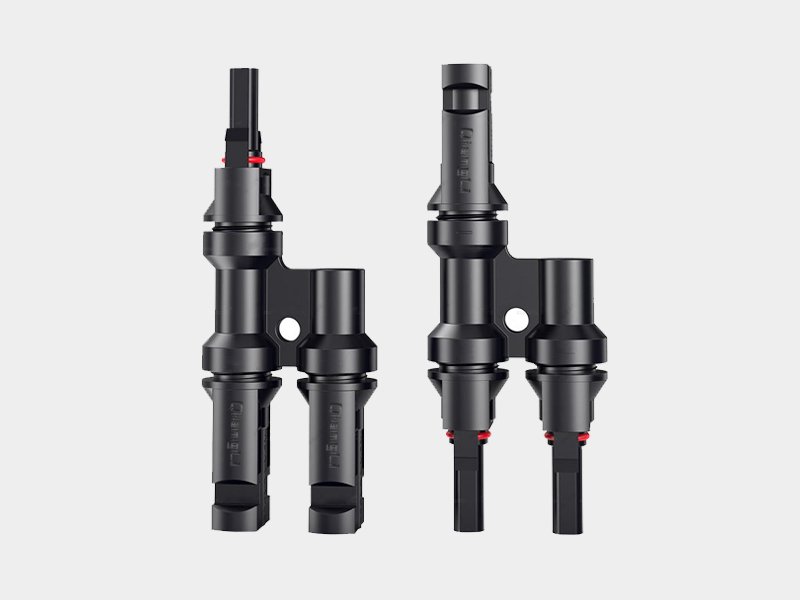
T-Branch Connector
Standard: IEC 62852
Configuration: T-shape — 2 inputs + 1 output (2-into-1 parallel)
Rated Voltage: 1500 V DC
Rated Current (per port): 30 A continuous
Max. Combined Output Current: 60 A (output cable must be sized accordingly)
Contact Resistance: < 0.5 mΩ per port
IP Rating: IP67 (all ports mated)
Operating Temperature: −40 °C to +85 °C
Contact Material: Tinned copper alloy (CuSn)
Housing Material: UV-stabilised PPO, halogen-free, UL 94 V-0
Product Overview
T-Branch MC4 Connector is a three-port MC4-compatible junction connector used to connect two PV strings in parallel into a single DC output cable. Its T-shaped body provides two input ports (one from each string) and one combined output port — all within a single weatherproof housing rated IP67 and 1500 V DC. Available in both positive (with male output) and negative (with female output) versions, a matched T-Branch pair replaces an external combiner box for small two-string systems, eliminating additional enclosures, terminals, and wiring complexity.
Each port uses the standard MC4 snap-lock interface, making the T-Branch fully compatible with all MC4-terminated solar cables and pre-assembled PV leads. The UV-stabilised PPO housing and tinned copper alloy contacts meet IEC 62852 and are certified by TUV Rheinland, ensuring 25-year outdoor service life under direct sunlight, rain, and temperature extremes from −40 °C to +85 °C.
The T-Branch is the simplest and most cost-effective way to parallel two strings — no tools, no enclosure, no additional cable entries. Plug in, click locked, done.
2-into-1 Parallel Connection
Combines two string inputs into one output in a single connector body — the fastest way to parallel two PV strings without a combiner box, fuse holders, or additional enclosures.
IP67 Fully Weatherproof
All three ports are individually sealed to IP67. The connector withstands direct rain, condensation, and temporary water immersion — safe for rooftop, ground-mount, and carport installations.
1500 V DC / 30 A per Port
Each input port is independently rated 30 A. The combined output carries up to 2 × string current — size the output cable cross-section accordingly to stay within ampacity limits.
Tool-Free MC4 Connection
All three ports use the standard MC4 snap-lock interface — plug in and click. No crimping at the T-Branch body itself; only the cable terminations at each port require a crimp tool.
Matched Positive + Negative Pair
Always ordered and installed as a pair — one positive T-Branch (two female inputs, one male output) and one negative T-Branch (two male inputs, one female output) — maintaining correct polarity throughout.
TUV Rheinland Certified
Certified to IEC 62852 by TUV Rheinland. UV, thermal cycling, humidity, and mechanical tests confirm 25-year outdoor performance — accepted by EPC contractors and project lenders worldwide.
Technical Specifications
Electrical & Mechanical Parameters
| Standard | IEC 62852 (DC connectors for PV systems) |
|---|---|
| Configuration | T-shape: 2 inputs + 1 output (2-into-1 parallel) |
| Rated Voltage | 1500 V DC |
| Rated Current (per port) | 30 A continuous |
| Max. Combined Output Current | 60 A (2 × 30 A strings; output cable must be sized accordingly) |
| Contact Resistance | < 0.5 mΩ per port (new); < 1.0 mΩ after ageing |
| Insulation Resistance | > 1000 MΩ (500 V DC test) |
| Dielectric Withstand | 6000 V DC / 1 min |
| IP Rating | IP67 (all ports mated) |
| Operating Temperature | −40 °C to +85 °C |
| Contact Material | Tinned copper alloy (CuSn) |
| Housing Material | UV-stabilised PPO, halogen-free, UL 94 V-0 |
| Compatible Cable Cross-Section | 2.5 mm² / 4 mm² / 6 mm² / 10 mm² |
| Cable Entry Range | OD 4.0–8.5 mm per port |
| Port Interface | Standard MC4-compatible snap-lock on all three ports |
| Versions | Positive: 2× female input + 1× male output / Negative: 2× male input + 1× female output |
| Disconnect | Requires MC4 spanner disconnect tool per port |
| Flammability | UL 94 V-0 |
| Certification | TUV Rheinland, CE, RoHS |
| Supply | Sold as pairs (1× positive + 1× negative T-Branch) |
Output Cable Sizing Guide
| String Input Current (each) | Combined Output Current | Min. Output Cable Cross-Section | Typical Module Config |
|---|---|---|---|
| ≤ 10 A | ≤ 20 A | 4 mm² | 60-cell modules, short strings |
| ≤ 13 A | ≤ 26 A | 6 mm² | 72-cell / half-cut modules |
| ≤ 15 A | ≤ 30 A | 6 mm² | High-power 400W+ modules |
| ≤ 20 A | ≤ 40 A | 10 mm² | High-current bifacial modules |
Certifications & Standards
How to Use the T-Branch Connector
The T-Branch replaces a two-input combiner box. Install one positive T-Branch and one negative T-Branch together to form a complete parallel junction for two strings.
Wiring Principle
String 1 positive → Input port A (female) of positive T-Branch
String 2 positive → Input port B (female) of positive T-Branch
Combined positive output ← Male output port of positive T-Branch → Inverter DC+ input
String 1 negative → Input port A (male) of negative T-Branch
String 2 negative → Input port B (male) of negative T-Branch
Combined negative output ← Female output port of negative T-Branch → Inverter DC− input
Installation Steps
- Switch off the inverter and verify zero DC voltage at all string outputs with a calibrated multimeter before making any connections.
- Identify positive and negative T-Branches: The positive T-Branch has two female input ports and one male output. The negative T-Branch has two male input ports and one female output. Never swap them — reversed polarity will damage the inverter.
- Connect String 1 positive lead (red, MC4 male from module end) into input port A of the positive T-Branch female socket. Push until the snap-lock clicks.
- Connect String 2 positive lead (red) into input port B of the positive T-Branch. Both input ports must be connected — leave no port open and unsealed.
- Connect the output lead from the positive T-Branch male port to the inverter DC+ input or combiner cable. Ensure the output cable cross-section is rated for the combined current of both strings.
- Repeat steps 3–5 for the negative T-Branch using the black (negative) string leads and connecting to the inverter DC− input.
- Inspect all connections: Verify each port is fully clicked and locked. Tug each cable to confirm retention. No port should be left open — cap any unused port with an MC4 blanking plug.
- Power up and verify: Switch on the inverter and confirm both strings are producing expected voltage and current. Any significant imbalance between strings may indicate a connection or orientation problem.
When NOT to Use a T-Branch
- Combined string current exceeds 30 A: Use a combiner box with rated breakers or fuses instead.
- Strings are significantly mismatched (different lengths, orientations, or shading profiles): Circulating currents between unequal strings can cause overheating. Use string-level fusing or a proper combiner box.
- More than 2 strings to combine: Use a Y-Branch (3-into-1) or a combiner box for 3+ strings.
Typical Applications
2-String Parallel Wiring
Connect two PV strings to one inverter MPPT input — no combiner box needed for small arrays.
Residential Rooftop PV
East-west split roof configurations where two string runs meet before the inverter.
Commercial Rooftop Arrays
Simplifies wiring on large rooftops where two parallel string runs per MPPT input are standard.
Ground-Mounted Solar
Combines adjacent row strings at the end of each tracker row before running a single trunk cable to the combiner.
Solar Carports
Pairs canopy rows into single output runs — reduces cable tray fill and simplifies DC trunk routing.
Off-Grid & Hybrid Systems
Combines two parallel string inputs to a charge controller input — eliminates a separate combiner enclosure.
Related Products
EN 50618 / TUV certified — 1.5–120 mm², bulk drum supply
Red + black paired — 2.5–16 mm², simplifies string polarity routing
H1Z2Z2-K with MC4 connectors factory-crimped — plug-and-play, 0.5–10 m
Request a Quote
Frequently Asked Questions
As a factory, we offer flexible MOQ depending on the cable type. For standard stock items, MOQ is low; for customized specifications, please contact our sales team for a detailed quote.
Yes, Qiangli cables are manufactured in compliance with international standards such as UL, CE, TUV, and VDE. We provide full test reports and certificates upon request.
Absolutely. We have a dedicated R&D team that can customize cable structure, material, color, and printing to meet your specific project needs.
For standard products, lead time is usually 7-15 days. For large-scale project orders or customized products, it typically ranges from 20 to 30 days.
Yes, we provide free samples for most standard cables. You only need to cover the international courier costs. Contact us to arrange your sample shipment.