
Product Overview
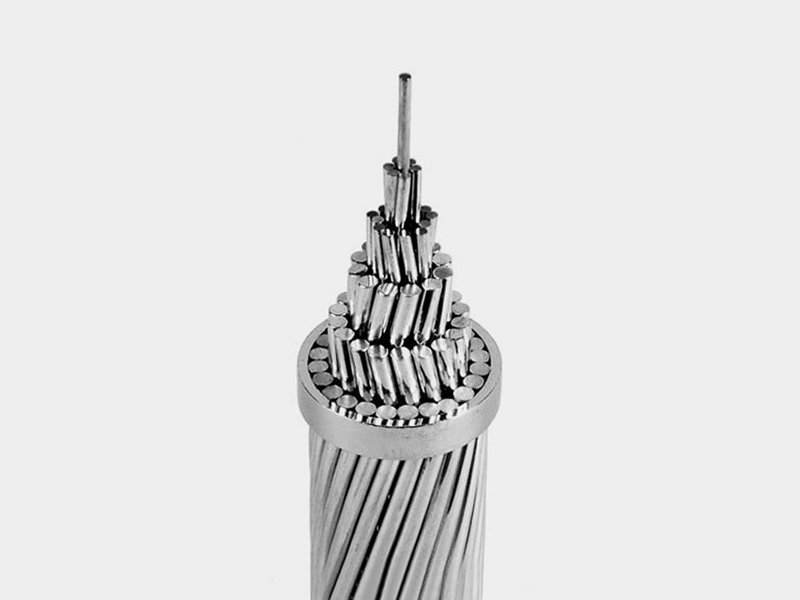
AAAC — All Aluminum Alloy Conductor (IEC 61089) is a concentric-lay stranded bare overhead conductor manufactured entirely from aluminium alloy 6201-T81 (Al-Mg-Si precipitation-hardened alloy, IEC designation A3), produced to IEC 61089 — Round wire concentric lay overhead electrical stranded conductors. Unlike AAC which uses commercially pure 1350-H19 aluminium, AAAC uses the age-hardened 6201 alloy which delivers significantly higher tensile strength — approximately 315 MPa versus 160–170 MPa for 1350-H19 — while maintaining adequate conductivity of 52.5% IACS. This combination makes AAAC the conductor of choice for applications that demand both mechanical strength and superior corrosion resistance without the weight penalty or galvanic corrosion risk of a steel core.
The core value proposition of AAAC over ACSR is the elimination of the bimetallic steel-aluminium interface. In ACSR, the aluminium and steel cores have different thermal expansion coefficients, and in corrosive environments the galvanic couple between steel and aluminium accelerates corrosion — a well-documented long-term failure mechanism on coastal and tropical overhead lines. AAAC uses only a single metal throughout, providing superior corrosion resistance at equivalent or better tensile strength, making it the preferred conductor for coastal regions, marine industrial zones, and tropical overhead line environments worldwide.
Available in sizes from 16 mm² to 1120 mm² in 19 standard cross-sections, covering rural distribution through high-voltage sub-transmission. Designated as Type A3 in IEC 61089 alloy classification.
Outer Layer — 6201-T81 aluminium alloy wire, right-hand concentric lay
Inner Layers — Successive alloy wire layers in alternating lay directions
Central Wire — Single 6201-T81 alloy wire (7-wire sizes); no steel core
IEC Designation — Type A3 (6201 alloy, 52.5% IACS, IEC 61089)
High Tensile Strength — 6201-T81 Alloy
Precipitation-hardened 6201-T81 alloy achieves approximately 315 MPa tensile strength — nearly double the 160–170 MPa of 1350-H19 pure aluminium. This enables AAAC to match or exceed ACSR sag performance on medium and long spans without a steel core.
No Steel Core — No Galvanic Corrosion
Single-metal all-alloy construction eliminates the bimetallic galvanic couple between steel and aluminium that drives ACSR core corrosion in coastal, marine, and tropical environments — the single most significant long-term reliability advantage of AAAC over ACSR.
52.5% IACS Conductivity
6201 alloy conductivity (52.5% IACS) is lower than pure 1350 aluminium (61% IACS) — the trade-off for higher strength. For a given span and sag limit, AAAC achieves higher strength-to-weight ratio than AAC while delivering more current-carrying cross-section than ACSR, where the steel core occupies conductor area without contributing to conductivity.
Superior Sag Performance
High tensile strength directly reduces sag at maximum operating temperature. AAAC achieves the same or lower sag as ACSR on the same span with equivalent total cross-section — enabling longer spans, fewer support structures, or higher ground clearance without changing tower heights.
Lighter Than ACSR for Equivalent Strength
Without the dense steel core (density 7.85 g/cm³ vs aluminium alloy 2.70 g/cm³), AAAC is significantly lighter than ACSR of equivalent tensile strength — reducing dead load on towers, poles, and hardware, and lowering wind and ice loading effects.
40+ Year Design Life
All-alloy construction with inherent oxide layer passivation, absence of bimetallic corrosion, and stable mechanical properties of age-hardened 6201-T81 contribute to a verified service life exceeding 40 years in overhead line applications — including coastal and tropical environments where ACSR service life is frequently compromised.
Technical Specifications
Basic Parameters
| Standard | IEC 61089 — Round wire concentric lay overhead electrical stranded conductors |
|---|---|
| IEC Alloy Designation | Type A3 — Aluminium alloy 6201 (Al-Mg-Si, precipitation hardened) |
| Alloy Temper | 6201-T81 (solution heat treated, strain hardened, artificially aged) |
| Conductivity | 52.5% IACS (≥ 29.75 m/Ω·mm²) |
| Tensile Strength (wire) | 295–325 MPa (depending on wire diameter per IEC 61089) |
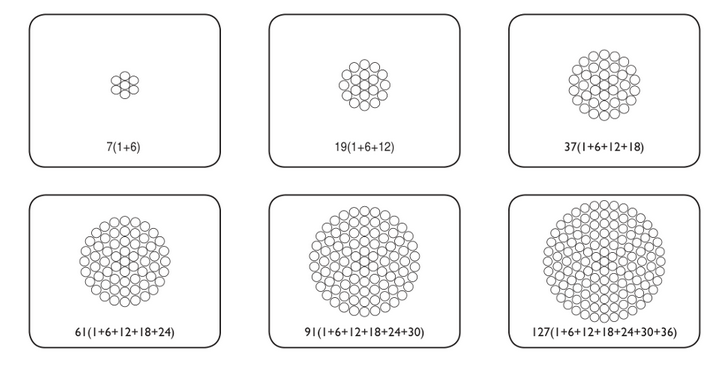
| Construction | Concentric-lay stranded, circular cross-section; adjacent layers in alternating lay directions |
| Nominal Cross-Section Range | 16 mm² to 1120 mm² — 19 standard sizes |
| Standard Wire Counts | 7 wires (16–54 mm²); 19 wires (100–250 mm²); 37 wires (315–500 mm²); 61 wires (560–800 mm²); 91 wires (900–1120 mm²) |
| Max. Continuous Temperature | 90 °C (IEC 61089 current rating basis for 6201 alloy) |
| Density | 2.703 g/cm³ |
| Coefficient of Linear Expansion | 23 × 10⁻⁶ /°C |
| Modulus of Elasticity (final) | 55–65 GPa (6201-T81 alloy stranded) |
| Surface Finish | Bare; grease-filled on request |
| Packaging | Wooden or steel drum; 500 m / 1000 m standard; custom lengths available |
Full Parameter Table — IEC 61089 AAAC Type A3 (16–1120 mm²)
| Nominal Area (mm²) | Stranding (No./mm) | Calc. Area (mm²) | Overall Ø (mm) | Weight (kg/km) | Calc. Breaking Load (kN) | DC Resistance (Ω/km, 20°C) | Current Rating* (A) | Std. Length (m/reel) |
|---|---|---|---|---|---|---|---|---|
| 16 | 7/1.70 | 15.9 | 5.10 | 43 | 5.05 | 1.8095 | 104 | 2000 |
| 25 | 7/2.13 | 24.9 | 6.39 | 67 | 7.86 | 1.1570 | 130 | 2000 |
| 35 | 7/2.52 | 34.8 | 7.56 | 94 | 10.60 | 0.8276 | 159 | 2000 |
| 54 | 7/3.13 | 53.9 | 9.39 | 146 | 15.82 | 0.5346 | 205 | 2000 |
| 100 | 19/2.59 | 100.0 | 12.95 | 272 | 30.65 | 0.2883 | 310 | 2000 |
| 125 | 19/2.89 | 124.5 | 14.45 | 338 | 38.20 | 0.2317 | 356 | 2000 |
| 150 | 19/3.17 | 149.9 | 15.85 | 407 | 45.95 | 0.1924 | 405 | 2000 |
| 200 | 19/3.66 | 199.9 | 18.30 | 543 | 61.20 | 0.1443 | 493 | 1000 |
| 250 | 19/4.09 | 249.6 | 20.45 | 678 | 76.50 | 0.1156 | 567 | 1000 |
| 315 | 37/3.29 | 315.0 | 23.03 | 856 | 101.96 | 0.0918 | 660 | 1000 |
| 355 | 37/3.50 | 356.1 | 24.50 | 967 | 115.04 | 0.0812 | 715 | 1000 |
| 400 | 37/3.71 | 400.1 | 25.97 | 1087 | 129.30 | 0.0722 | 773 | 1000 |
| 450 | 37/3.94 | 451.7 | 27.58 | 1227 | 145.80 | 0.0639 | 830 | 1000 |
| 500 | 37/4.15 | 501.2 | 29.05 | 1361 | 161.80 | 0.0576 | 900 | 1000 |
| 560 | 61/3.42 | 561.0 | 30.78 | 1525 | 181.40 | 0.0513 | 966 | 1000 |
| 630 | 61/3.63 | 632.0 | 32.67 | 1717 | 204.10 | 0.0456 | 1038 | 1000 |
| 710 | 61/3.85 | 712.0 | 34.65 | 1934 | 230.00 | 0.0405 | 1112 | 1000 |
| 800 | 61/4.09 | 803.0 | 36.81 | 2181 | 259.20 | 0.0359 | 1201 | 1000 |
| 900 | 91/3.54 | 898.0 | 38.94 | 2439 | 290.40 | 0.0321 | 1290 | 1000 |
| 1000 | 91/3.74 | 1000.0 | 41.14 | 2717 | 323.00 | 0.0289 | 1385 | 1000 |
| 1120 | 91/3.96 | 1120.0 | 43.56 | 3042 | 361.60 | 0.0258 | 1490 | 1000 |
Key Features & Technical Advantages
AAAC vs AAC vs ACSR — Conductor Selection Guide
| Parameter | AAAC (IEC A3) | AAC (IEC A1) | ACSR (IEC A1/Sxy) |
|---|---|---|---|
| Conductor material | 6201-T81 alloy (all alloy) | 1350-H19 pure Al (all Al) | 1350-H19 Al + steel core |
| Conductivity (% IACS) | 52.5% | 61% (highest) | 61% (Al only, reduced by steel area) |
| Tensile strength | High (~315 MPa) | Moderate (~160–170 MPa) | Very high (steel core) |
| Corrosion resistance | Excellent (single metal) | Excellent (single metal) | Good (galvanic risk at interface) |
| Weight | Light (no steel) | Light (no steel) | Heavier (steel core density) |
| Sag at max. temp. | Low (high UTS) | Higher (lower UTS) | Low (steel creep resistance) |
| Best for | Long/medium spans, coastal, no steel | Short-medium spans, urban, max. conductivity | Very long spans, heavy ice/wind zones |
| Max. conductor temp. | 90 °C | 80 °C | 80 °C (Al) / higher for HT grades |
6201-T81 — The Optimal Overhead Alloy
Al-Mg-Si alloy 6201 in the T81 temper (solution treated, strain hardened, artificially aged) achieves the best balance of conductivity and tensile strength available in a single-metal aluminium conductor. The Mg₂Si precipitation hardening mechanism delivers strength without the conductivity sacrifice of higher-alloy compositions.
Higher Operating Temperature — 90°C
6201-T81 alloy is thermally more stable than 1350-H19 aluminium — it retains its T81 temper strength at 90°C continuous operation, where 1350-H19 is limited to 80°C. The additional 10°C operating margin directly increases line ampacity, enabling higher throughput on the same conductor cross-section.
Longer Spans — Lower Tower Count
AAAC's high tensile strength enables longer spans than AAC on the same sag limit — reducing the number of poles or towers required for a given line route. Tower count reduction is the largest single driver of overhead line capital cost; AAAC consistently delivers 10–20% fewer structures than AAC on medium-to-long span designs.
Preferred for Coastal & Marine Lines
The combination of high strength and single-metal construction makes AAAC the globally preferred conductor for coastal overhead lines. No steel core means no galvanic cell, no differential corrosion at the aluminium-steel interface, and no core failure that leaves the aluminium shell intact but mechanically unsupported — the silent failure mode of coastal ACSR installations.
Better Strength-to-Weight Ratio Than ACSR
For equal tensile strength, AAAC is lighter than ACSR (no dense steel core). This reduces dead load on support structures, wind and ice load, and foundation requirements — particularly significant for transmission lines crossing difficult terrain where structure weight and foundation cost dominate the capital budget.
Single-Drum Reel — Reduced Jointing
Standard reel lengths of 2000 m (small sizes) and 1000 m (large sizes) per IEC 61089 minimise the number of compression joints required on long line sections — each joint is a potential failure point and installation cost. Longer standard reel lengths reduce both jointing costs and the number of joint inspections required over the line lifetime.
Certifications & Standards
Typical Applications
Coastal & Marine Overhead Lines
The primary application for AAAC globally — coastal HV and MV lines where salt air, humidity, and marine spray make galvanic corrosion in ACSR the dominant long-term reliability risk.
Tropical & High-Humidity Networks
High annual rainfall, condensation, and humidity environments in tropical Africa, Southeast Asia, and South America where ACSR steel core corrosion is a well-documented 20–30 year failure mechanism.
Long-Span Transmission Lines
River crossings, valley spans, and mountain approaches where AAAC's high tensile strength enables span lengths that would require ACSR or special conductor types with AAC.
High-Altitude & Remote Lines
Lines crossing mountain terrain where longer spans reduce the number of high-altitude tower foundations — AAAC's superior strength-to-weight ratio enables fewer structures per km.
Urban Sub-Transmission (33–132 kV)
Medium and large cross-section AAAC (315–800 mm²) for sub-transmission feeders in urban areas where space constraints limit tower count and right-of-way requires longer spans.
Industrial & Chemical Zone Lines
Overhead lines in petrochemical zones, fertiliser plants, and chemical industrial areas where atmospheric pollution accelerates ACSR core corrosion — AAAC eliminates the risk.
Agricultural & Rural Distribution
Medium cross-section AAAC (100–250 mm²) for rural 11–33 kV distribution in coastal and humid agricultural areas — longer spans reduce pole count on long rural feeder routes.
ACSR Replacement & Upgrade
Replacement of corroded ACSR on existing coastal and tropical lines — AAAC provides direct improvement in corrosion resistance with comparable or better sag performance on the same span-pole configuration.