
Product Overview
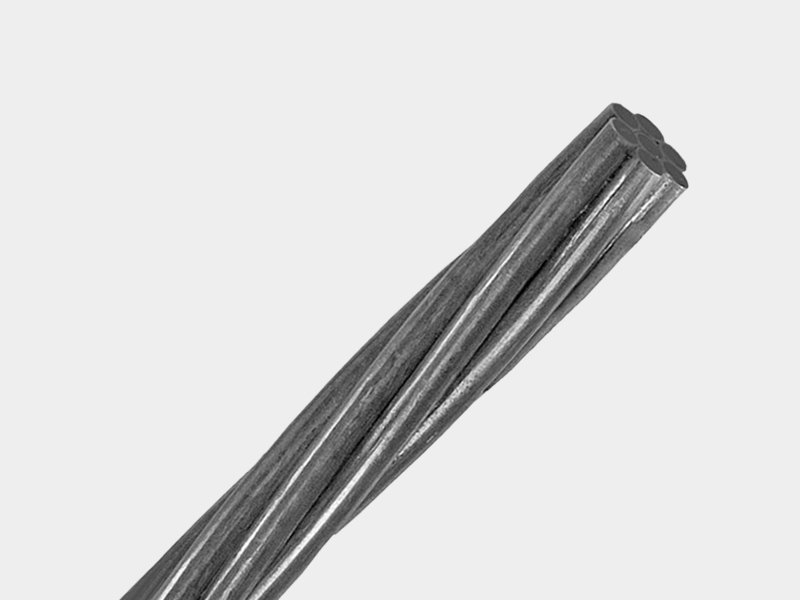
GSW — Galvanized Steel Wire Strand (BS 183) is a concentric-lay stranded high-carbon steel wire conductor, hot-dip zinc galvanised, manufactured to BS 183:1972 — British Standard Specification for Galvanised Steel Wire Strand. BS 183 is the overhead ground wire, guy wire, and messenger wire standard for the United Kingdom and the extensive Commonwealth market — governing Guy Wire procurement across sub-Saharan Africa, South Asia, Southeast Asia, the Caribbean, and all countries whose electrical infrastructure standards are based on British practice.
A defining characteristic of BS 183 is its seven strength grades — Grade 350, 480, 700, 850, 1000, 1150, and 1300 (units: N/mm² minimum wire tensile strength) — the most granular strength classification of the three Guy Wire standards (ASTM A475 has 4 grades, IEC 61089 has 4 grades). This fine resolution allows engineers to precisely match the strand breaking load to the structural requirements of each specific application without over-specifying. Grades 700 and 1000 are the most widely used in Commonwealth utility practice. BS 183 also provides the widest size range — individual wire diameters from 0.56 mm to 4.75 mm in 3-wire, 4-wire, 5-wire, 7-wire, and 19-wire constructions — covering everything from light telecommunications support strand to the heaviest EHV transmission tower guy wire.
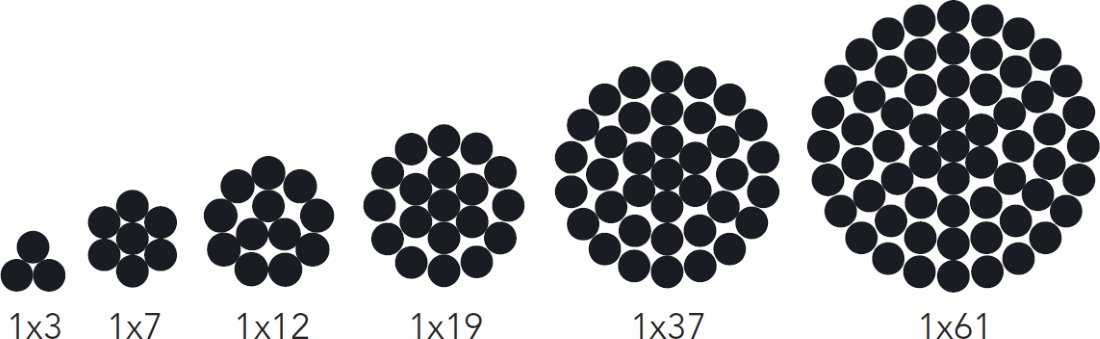
Outer Steel Wires — High-carbon drawn steel, hot-dip zinc galvanised (Class A / B / C)
Inner Layers — Concentric-lay, alternating direction per layer
Central Wire — Single steel wire core
BS 183 Grade — 7 grades (350 to 1300 N/mm²) identified by minimum wire tensile strength
Seven Strength Grades — 350 to 1300
BS 183 defines seven grades by minimum wire tensile strength (N/mm²): 350 / 480 / 700 / 850 / 1000 / 1150 / 1300. This finer gradation than ASTM A475 (4 grades) and IEC 61089 (4 grades) enables more precise structural design — selecting exactly the breaking load required without the safety margin waste of a coarser grade system.
Widest Size Range — 0.56 mm to 4.75 mm Wire
BS 183 covers individual wire diameters from 0.56 mm (7/0.56, 14 kg/km — telecommunications support) to 4.75 mm (19/4.75, 2630 kg/km — major transmission tower guying), spanning a 70× range in weight. No other Guy Wire standard covers this breadth in a single document.
Multiple Construction Types — 3 to 19 Wires
3-wire (triangular), 4-wire (square), 5-wire (pentagonal), 7-wire (hexagonal), and 19-wire (two-layer hexagonal) constructions are all defined in BS 183. The 3/4/5-wire configurations are unique to BS 183 and not available in ASTM A475 or IEC 61089 — providing compact, lightweight strand options for light-duty applications not covered by other standards.
BS 183 — British & Commonwealth Standard
Full compliance with the British national standard for galvanised steel strand — accepted by UK Distribution Network Operators (DNOs) and the National Grid, and specified for overhead line guying and messenger wire across Nigeria, Ghana, Kenya, Pakistan, Bangladesh, Malaysia, Singapore, Hong Kong, and all Commonwealth utility networks.
Hot-Dip Zinc Galvanising — Three Coating Classes
Class A (standard), Class B (medium), and Class C (heavy) zinc coating weights per BS 183 — providing progressive corrosion protection levels from standard inland environments (Class A) through coastal and industrial pollution (Class B) to severe marine and tropical environments (Class C).
Grade 700 & 1000 — Commonwealth Workhorses
Grade 700 (7/3.25 mm, 7/4.00 mm) and Grade 1000 (7/3.25 mm through 19/4.75 mm) are the dominant specifications in Commonwealth utility practice across sub-Saharan Africa and South Asia — used for standard distribution pole guying and HV transmission tower guys respectively. Specifying "7/3.25 mm Grade 700" is unambiguous across all Commonwealth utility markets.
Technical Specifications
Basic Parameters
| Standard | BS 183:1972 — British Standard Specification for Galvanised Steel Wire Strand |
|---|---|
| Wire Material | High-carbon drawn steel wire, hot-dip zinc galvanised |
| Strength Grades | Grade 350 / 480 / 700 / 850 / 1000 / 1150 / 1300 (N/mm² min. wire tensile strength) |
| Zinc Coating Classes | Class A (standard) / Class B (medium) / Class C (heavy — severe environments) |
| Construction Types | 3-wire / 4-wire / 5-wire / 7-wire / 19-wire concentric-lay |
| Wire Diameter Range | 0.56 mm to 4.75 mm (individual wire) |
| Overall Diameter Range | 1.7 mm (3/0.56 mm construction) to 23.8 mm (19/4.75 mm construction) |
| Primary Use | Mechanical / structural — guy wire, stay wire, messenger wire, overhead earth wire |
| Conductivity | ~17% IACS (steel) — not a current-carrying conductor |
| Packaging | Wooden or steel drum; standard lengths 500 m / 1000 m; custom lengths available |
BS 183 Grade vs ASTM A475 / IEC 61089 Cross-Reference
| BS 183 Grade | Min. Wire Tensile (N/mm²) | ASTM A475 Approx. Equiv. | IEC 61089 Approx. Equiv. | Typical Application |
|---|---|---|---|---|
| Grade 350 | 350 | Below Common | Below S1A | Light telecommunications support, decorative cable, temporary strand |
| Grade 480 | 480 | Common (C) | S1A (approx.) | Light-duty distribution guying, low-load stay wire |
| Grade 700 | 700 | Siemens-Martin (SM) | S1B / S2A (approx.) | Standard distribution pole guying — the most common BS 183 grade in Commonwealth practice |
| Grade 850 | 850 | High-Strength (HS) | S2A (approx.) | Heavy distribution guying, sub-transmission pole guys |
| Grade 1000 | 1000 | Extra High-Strength (EHS) | S3A (approx.) | HV transmission tower guys, long-span overhead earth wire |
| Grade 1150 | 1150 | Above EHS | Above S3A | EHV tower guys, heavy mechanical loading, long river crossings |
| Grade 1300 | 1300 | Above EHS (max.) | Above S3A (max.) | Maximum breaking load — extreme span and loading applications |
Full Parameter Table — BS 183 GSW (Hongda Data)
| No./Wire Ø (mm) | Overall Ø (mm) | Weight (kg/km) | Min. Breaking Load Grade 350 (kN) | Min. Breaking Load Grade 480 (kN) | Min. Breaking Load Grade 700 (kN) | Min. Breaking Load Grade 850 (kN) | Min. Breaking Load Grade 1000 (kN) | Min. Breaking Load Grade 1150 (kN) | Min. Breaking Load Grade 1300 (kN) |
|---|---|---|---|---|---|---|---|---|---|
| 3/1.80 | 3.9 | 60 | 2.65 | 3.66 | — | — | — | — | — |
| 3/2.65 | 5.7 | 130 | 5.80 | 7.95 | — | — | — | — | — |
| 3/3.25 | 7.0 | 195 | 8.70 | 11.95 | — | — | — | — | — |
| 3/4.00 | 8.6 | 295 | 13.20 | 18.10 | — | — | — | — | — |
| 4/1.80 | 4.4 | 80 | 3.55 | 4.90 | — | — | — | — | — |
| 4/2.65 | 6.4 | 172 | 7.70 | 10.60 | — | — | — | — | — |
| 4/3.25 | 7.9 | 260 | 11.60 | 15.90 | — | — | — | — | — |
| 4/4.00 | 9.7 | 390 | 17.60 | 24.10 | 35.20 | — | — | — | — |
| 5/1.50 | 4.1 | 69 | 3.10 | 4.24 | 6.18 | — | — | — | — |
| 5/1.80 | 4.9 | 95 | 4.45 | 6.10 | 8.90 | — | — | — | — |
| 5/2.65 | 7.2 | 220 | 9.65 | 13.25 | 19.30 | — | — | — | — |
| 5/3.25 | 8.8 | 320 | 14.50 | 19.90 | 29.00 | — | — | — | — |
| 5/4.00 | 10.8 | 490 | 22.00 | 30.15 | 43.95 | — | — | — | — |
| 7/0.56 | 1.7 | 14 | 0.60 | 0.83 | 1.20 | 1.70 | 1.98 | 2.24 | — |
| 7/0.71 | 2.1 | 28 | 0.97 | 1.33 | 1.94 | 2.75 | 3.19 | 3.60 | — |
| 7/0.85 | 2.6 | 31 | 1.39 | 1.90 | 2.80 | 3.95 | 4.57 | 5.15 | — |
| 7/0.90 | 2.7 | 35 | 1.55 | 2.14 | 3.10 | 4.45 | 5.12 | 5.80 | — |
| 7/1.00 | 3.0 | 43 | 1.92 | 2.64 | 3.85 | 5.50 | 6.32 | 7.15 | — |
| 7/1.25 | 3.8 | 67 | 3.01 | 4.10 | 6.00 | 8.55 | 9.88 | 11.15 | — |
| 7/1.40 | 4.2 | 84 | 3.75 | 5.17 | 7.54 | 9.16 | 10.75 | 12.35 | 14.00 |
| 7/RSc | 4.3 | 86 | 3.85 | 5.28 | 7.70 | 9.35 | 11.00 | 12.65 | 14.30 |
| 7/1.60 | 4.8 | 110 | 4.90 | 6.75 | 9.85 | 11.95 | 14.10 | 16.20 | 18.30 |
| 7/1.80 | 5.4 | 140 | 6.23 | 8.55 | 12.45 | 17.80 | 20.50 | 23.20 | — |
| 7/2.00 | 6.0 | 170 | 7.70 | 10.55 | 15.40 | 22.00 | 25.30 | 28.60 | — |
| 7/2.36 | 7.1 | 240 | 10.70 | 14.70 | 21.40 | 30.60 | 35.20 | 39.80 | — |
| 7/2.65 | 8.0 | 300 | 13.50 | 18.50 | 27.00 | 38.60 | 44.40 | 50.20 | — |
| 7/3.00 | 9.0 | 392 | 17.30 | 23.75 | 34.65 | 49.50 | 56.90 | 64.30 | — |
| 7/3.15 | 9.5 | 430 | 19.10 | 26.20 | 38.20 | 54.55 | 62.75 | 70.90 | — |
| 7/3.25 | 9.8 | 460 | 20.30 | 27.85 | 40.65 | 58.05 | 66.80 | 75.50 | — |
| 7/3.65 | 11.0 | 570 | 25.60 | 35.15 | 51.25 | 73.25 | 84.20 | 95.20 | — |
| 7/4.00 | 12.0 | 690 | 30.90 | 42.20 | 61.60 | 88.00 | 101.00 | 114.00 | — |
| 7/4.25 | 12.8 | 780 | 34.75 | 47.65 | 69.50 | 99.30 | 114.00 | 129.00 | — |
| 7/4.75 | 14.0 | 970 | 43.40 | 59.45 | 86.80 | 124.00 | 142.70 | 161.30 | — |
| 19/1.00 | 5.0 | 120 | 5.22 | 7.16 | 10.45 | 14.92 | 17.16 | 19.40 | — |
| 19/1.25 | 6.3 | 180 | 8.16 | 11.19 | 16.32 | 23.32 | 26.81 | 30.31 | — |
| 19/1.40 | 7.0 | 230 | 10.24 | 14.04 | 20.47 | 29.25 | 33.64 | 38.02 | — |
| 19/1.60 | 8.0 | 300 | 13.37 | 18.34 | 26.75 | 38.20 | 43.93 | 49.66 | — |
| 19/2.00 | 10.0 | 470 | 20.90 | 28.65 | 41.78 | 50.74 | 59.69 | 68.64 | 77.60 |
| 19/2.50 | 12.5 | 730 | 32.65 | 44.80 | 65.29 | 79.28 | 93.27 | 107.30 | 121.30 |
| 19/3.00 | 15.0 | 1050 | 47.00 | 64.50 | 94.00 | 114.10 | 134.30 | 154.50 | 174.60 |
| 19/3.55 | 17.8 | 1470 | 65.80 | 90.27 | 131.60 | 159.90 | 188.00 | 216.30 | 244.50 |
| 19/4.00 | 20.0 | 1870 | 83.55 | 114.60 | 167.10 | 203.00 | 238.70 | 274.60 | 310.40 |
| 19/4.75 | 23.8 | 2630 | 117.85 | 161.60 | 235.70 | 286.00 | 336.70 | 387.20 | 437.70 |
Key Features & Technical Advantages
Seven Grades — Most Granular Grade System
BS 183's seven strength grades (350 to 1300 N/mm²) allow structural engineers to select the optimal breaking load for each specific application — avoiding the 30–50% over-specification that can result from the coarser 4-grade systems of ASTM A475 and IEC 61089. More precise grade selection reduces material cost without compromising safety factors.
3-Wire & 4-Wire Constructions — Unique to BS 183
3-wire and 4-wire constructions give triangular and square cross-section strand profiles — not available in ASTM A475 or IEC 61089. These compact constructions have a higher strength-to-weight ratio for light-duty applications and smaller overall diameter, fitting through conduits and cable entry points where 7-wire strand would be too large.
Grade 700 — Standard Commonwealth Distribution Guy
Grade 700, 7/3.25 mm (9.8 mm OD, 460 kg/km, 40.65 kN) is the de-facto standard guy wire specification for wood-pole distribution lines across Nigeria, Ghana, Kenya, Pakistan, and Malaysia — the same way that ASTM EHS 3/8" is the US standard. Specifying "BS 183, Grade 700, 7/3.25 mm" is unambiguous across all Commonwealth utility stores and project managers.
Grade 1000 & 1150 — Transmission Tower Guys
Grade 1000 and Grade 1150, 19-wire constructions (19/3.55 mm through 19/4.75 mm) are the standard specifications for steel lattice transmission tower guying in Commonwealth HV and EHV line projects — providing breaking loads of 188–387 kN for the largest tower structure loads in 400 kV and 500 kV transmission infrastructure.
7/RSc — Special Round Steel Centre
The 7/RSc construction is unique to BS 183 — a 7-wire strand with a round steel centre wire (rather than the standard hexagonal-pack centre) that provides a perfectly circular cross-section and slightly different mechanical properties. Specified in some Commonwealth utility standards for specific guying applications requiring exact dimensional compatibility with legacy fittings.
Commonwealth Hardware Compatibility
BS 183 strand dimensions are matched to Commonwealth-standard guy wire hardware — thimble eyes, anchor shackles, stay rods, and dead-end clamps catalogued by wire diameter and construction in Commonwealth utility hardware specifications. No conversion or special fittings needed for replacement or extension of existing BS 183 guy wire installations.
Certifications & Standards
Typical Applications
Distribution Pole Guy Wire
Grade 700 / 7/3.25 mm — standard guying for wood-pole 11 kV and 33 kV distribution lines across Commonwealth Africa, South Asia, and Southeast Asia.
Transmission Tower Guy Wire
Grade 1000–1150 / 19-wire — guying of steel lattice HV and EHV transmission towers on Commonwealth-standard lines across Nigeria, Ghana, Kenya, Pakistan, and Malaysia.
Overhead Earth Wire
Grade 700–1000 / 7-wire and 19-wire — overhead ground wire on Commonwealth-standard HV lines for lightning shielding and fault current path to earth.
Messenger Wire
Smaller 7-wire and 19-wire BS 183 sizes — support strand for aerial telecommunications cable, self-supporting power cable, and lashed cable on Commonwealth utility poles.
River & Valley Crossings
Grade 1150–1300 / 19-wire (19/4.00 to 19/4.75 mm) — long-span overhead earth wire crossings of rivers and valleys on Commonwealth-standard transmission lines; breaking loads up to 437.7 kN.
West African Utilities
Standard guy wire specification for Nigerian, Ghanaian, and Ivorian utility distribution and sub-transmission line construction — Grade 700 and Grade 1000 dominant sizes.
East & Southern African Lines
Distribution and transmission line guying in Kenya, Tanzania, Uganda, Zambia, Zimbabwe, and South Africa — all built to BS 183 specifications with Commonwealth-standard hardware.
South Asian Distribution
Standard guy wire for distribution line construction in Pakistan, Bangladesh, and Sri Lanka — BS 183 Grade 700 is the default utility procurement specification for these markets.